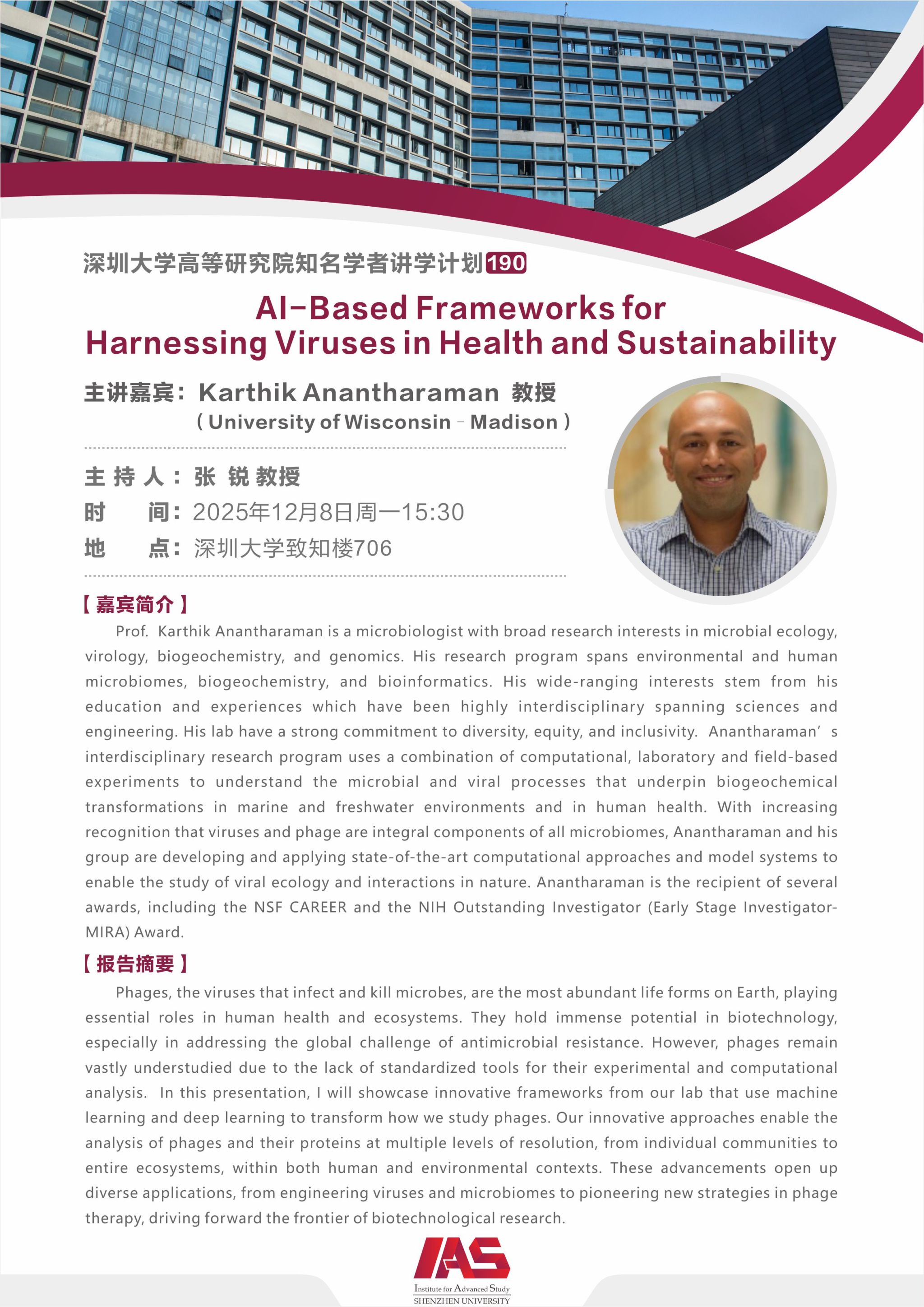
报告主题:AI-Based Frameworks for Harnessing Viruses in Health and Sustainability
主 讲 人:Karthik Anantharaman教授(University of Wisconsin–Madison)
主 持 人:张 锐 教授
时 间:2025年12月8日(一)15:00
地 点:致知楼706
嘉宾简介:
Prof. Karthik Anantharaman is a microbiologist with broad research interests in microbial ecology, virology, biogeochemistry, and genomics. His research program spans environmental and human microbiomes, biogeochemistry, and bioinformatics. His wide-ranging interests stem from his education and experiences which have been highly interdisciplinary spanning sciences and engineering. His lab have a strong commitment to diversity, equity, and inclusivity. Anantharaman’s interdisciplinary research program uses a combination of computational, laboratory and field-based experiments to understand the microbial and viral processes that underpin biogeochemical transformations in marine and freshwater environments and in human health. With increasing recognition that viruses and phage are integral components of all microbiomes, Anantharaman and his group are developing and applying state-of-the-art computational approaches and model systems to enable the study of viral ecology and interactions in nature. Anantharaman is the recipient of several awards, including the NSF CAREER and the NIH Outstanding Investigator (Early Stage Investigator-MIRA) Award.
报告摘要:
Phages, the viruses that infect and kill microbes, are the most abundant life forms on Earth, playing essential roles in human health and ecosystems. They hold immense potential in biotechnology, especially in addressing the global challenge of antimicrobial resistance. However, phages remain vastly understudied due to the lack of standardized tools for their experimental and computational analysis. In this presentation, I will showcase innovative frameworks from our lab that use machine learning and deep learning to transform how we study phages. Our innovative approaches enable the analysis of phages and their proteins at multiple levels of resolution, from individual communities to entire ecosystems, within both human and environmental contexts. These advancements open up diverse applications, from engineering viruses and microbiomes to pioneering new strategies in phage therapy, driving forward the frontier of biotechnological research.