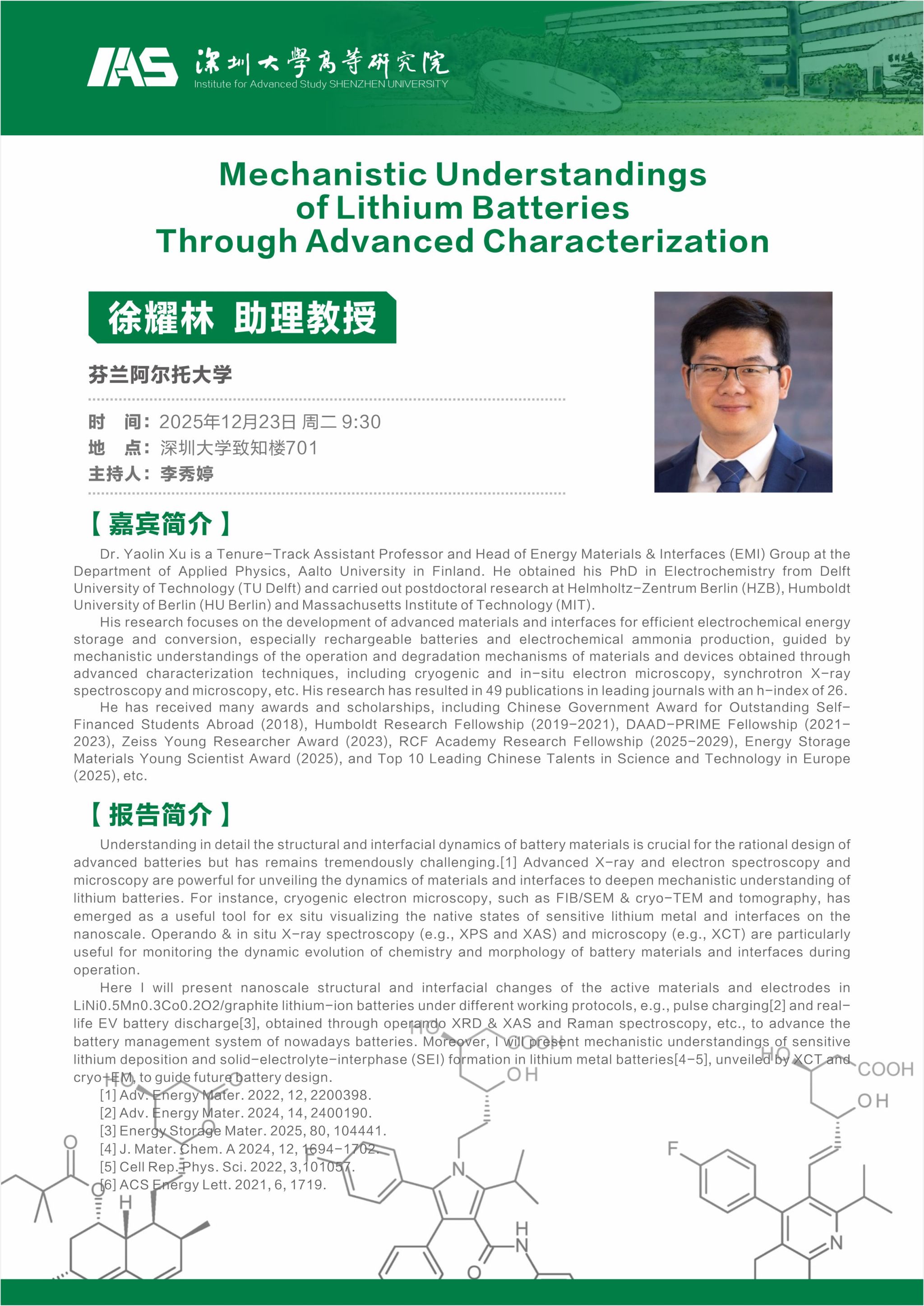
报告主题:Mechanistic Understandings of Lithium Batteries Through Advanced Characterization
主 讲 人:徐耀林 助理教授(芬兰阿尔托大学)
主 持 人:李秀婷
时 间:2025年12月23日(二)9:30
地 点:致知楼701
嘉宾简介:
Dr. Yaolin Xu is a Tenure-Track Assistant Professor and Head of Energy Materials & Interfaces (EMI) Group at the Department of Applied Physics, Aalto University in Finland. He obtained his PhD in Electrochemistry from Delft University of Technology (TU Delft) and carried out postdoctoral research at Helmholtz-Zentrum Berlin (HZB), Humboldt University of Berlin (HU Berlin) and Massachusetts Institute of Technology (MIT).
His research focuses on the development of advanced materials and interfaces for efficient electrochemical energy storage and conversion, especially rechargeable batteries and electrochemical ammonia production, guided by mechanistic understandings of the operation and degradation mechanisms of materials and devices obtained through advanced characterization techniques, including cryogenic and in-situ electron microscopy, synchrotron X-ray spectroscopy and microscopy, etc. His research has resulted in 49 publications in leading journals with an h-index of 26.
He has received many awards and scholarships, including Chinese Government Award for Outstanding Self-Financed Students Abroad (2018), Humboldt Research Fellowship (2019-2021), DAAD-PRIME Fellowship (2021-2023), Zeiss Young Researcher Award (2023), RCF Academy Research Fellowship (2025-2029), Energy Storage Materials Young Scientist Award (2025), and Top 10 Leading Chinese Talents in Science and Technology in Europe (2025), etc.
报告摘要:
Understanding in detail the structural and interfacial dynamics of battery materials is crucial for the rational design of advanced batteries but has remains tremendously challenging.[1] Advanced X-ray and electron spectroscopy and microscopy are powerful for unveiling the dynamics of materials and interfaces to deepen mechanistic understanding of lithium batteries. For instance, cryogenic electron microscopy, such as FIB/SEM & cryo-TEM and tomography, has emerged as a useful tool for ex situ visualizing the native states of sensitive lithium metal and interfaces on the nanoscale. Operando & in situ X-ray spectroscopy (e.g., XPS and XAS) and microscopy (e.g., XCT) are particularly useful for monitoring the dynamic evolution of chemistry and morphology of battery materials and interfaces during operation.
Here I will present nanoscale structural and interfacial changes of the active materials and electrodes in LiNi0.5Mn0.3Co0.2O2/graphite lithium-ion batteries under different working protocols, e.g., pulse charging[2] and real-life EV battery discharge[3], obtained through operando XRD & XAS and Raman spectroscopy, etc., to advance the battery management system of nowadays batteries. Moreover, I will present mechanistic understandings of sensitive lithium deposition and solid-electrolyte-interphase (SEI) formation in lithium metal batteries[4-5], unveiled by XCT and cryo-EM, to guide future battery design.
[1] Adv. Energy Mater. 2022, 12, 2200398.
[2] Adv. Energy Mater. 2024, 14, 2400190.
[3] Energy Storage Mater. 2025, 80, 104441.
[4] J. Mater. Chem. A 2024, 12, 1694-1702.
[5] Cell Rep. Phys. Sci. 2022, 3,101057.
[6] ACS Energy Lett. 2021, 6, 1719.