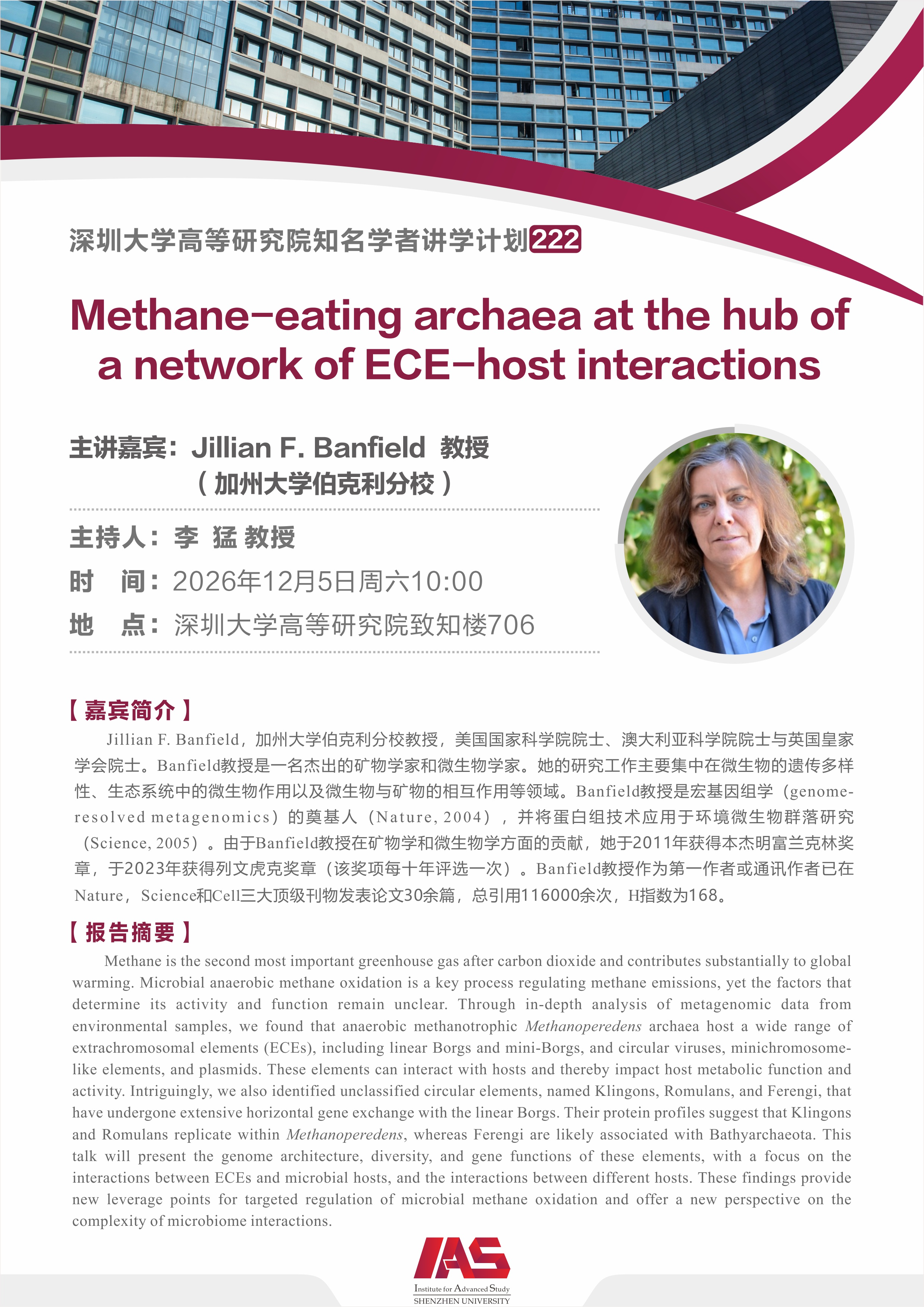
报告主题:Methane-eating archaea at the hub of a network of ECE-host interactions
主 讲 人:Jillian F. Banfield 教授(加拿大伯克利大学)
主 持 人:李猛 教授
时 间:2026年12月5日(六)10:00
地 点:致知楼706
嘉宾简介:
Jillian F. Banfield,加州大学伯克利分校教授,美国国家科学院院士、澳大利亚科学院院士与英国皇家学会院士。Banfield教授是一名杰出的矿物学家和微生物学家。她的研究工作主要集中在微生物的遗传多样性、生态系统中的微生物作用以及微生物与矿物的相互作用等领域。Banfield教授是宏基因组学(genome-resolved metagenomics)的奠基人(Nature, 2004),并将蛋白组技术应用于环境微生物群落研究(Science, 2005)。由于Banfield教授在矿物学和微生物学方面的贡献,她于2011年获得本杰明富兰克林奖章,于2023年获得列文虎克奖章(该奖项每十年评选一次)。Banfield教授作为第一作者或通讯作者已在Nature,Science和Cell三大顶级刊物发表论文30余篇,总引用116000余次,H指数为168。
报告摘要:
Methane is the second most important greenhouse gas after carbon dioxide and contributes substantially to global warming. Microbial anaerobic methane oxidation is a key process regulating methane emissions, yet the factors that determine its activity and function remain unclear. Through in-depth analysis of metagenomic data from environmental samples, we found that anaerobic methanotrophic Methanoperedens archaea host a wide range of extrachromosomal elements (ECEs), including linear Borgs and mini-Borgs, and circular viruses, minichromosome-like elements, and plasmids. These elements can interact with hosts and thereby impact host metabolic function and activity. Intriguingly, we also identified unclassified circular elements, named Klingons, Romulans, and Ferengi, that have undergone extensive horizontal gene exchange with the linear Borgs. Their protein profiles suggest that Klingons and Romulans replicate within Methanoperedens, whereas Ferengi are likely associated with Bathyarchaeota. This talk will present the genome architecture, diversity, and gene functions of these elements, with a focus on the interactions between ECEs and microbial hosts, and the interactions between different hosts. These findings provide new leverage points for targeted regulation of microbial methane oxidation and offer a new perspective on the complexity of microbiome interactions.