On December 4, 2025, Professor Zhichao Zhou's research group published a review article titled “Cellular and viral RNA polymerases: evolutionary insights into eukaryotic origins” in Trends in Microbiology.
This review explores the structural relationships between cellular and viral RNA polymerases and discusses their implications for the evolutionary history of life, providing a new theoretical perspective for understanding the origin of eukaryotes. Professor Zhichao Zhou serves as the corresponding author, Dr. Kuan Yee Wong as the first author, and the Shenzhen University Institute for Advanced Study as the primary affiliation.
Nucleocytoplasmic large DNA viruses (NCLDVs) encode multi-subunit RNA polymerases that challenge conventional views of viral evolution. Evidence from phylogenetic analyses and structural biology indicates that NCLDV RNA polymerases share remarkable architectural similarities with their eukaryotic counterparts and may even trace back to a deeply shared evolutionary origin. These viral RNA polymerases have adapted to virus-specific regulatory mechanisms, demonstrating remarkable plasticity and evolutionary innovation.
The article not only compares the structural differences between viral and cellular RNA polymerases but also integrates evidence from evolutionary biology, virology, and structural biology, further strengthening the theoretical framework of Viral Eukaryogenesis - the hypothesis that viruses contributed significantly to the emergence of eukaryotic life. The article argues that considering viruses as active contributors to evolutionary innovation, rather than merely parasitic entities, may reshape our understanding of RNA polymerase adaptability, diversification and evolutionary trajectories.
The authors highlight that this research direction is not only critical for reconstructing early evolutionary history but also holds potential applications in synthetic biology, artificial transcription system engineering, and cross-species genetic innovation. These findings provide new perspectives on virus-eukaryote co-evolution and offers fresh insights into questions surrounding the origin of life.
This work was supported by the Shenzhen Medical Research Fund, the Youth Fund of the National Natural Science Foundation of China, National Key Research and Development Program of China, Start-up fund from Institute for Advanced Study, and the research fund from Synthetic Biology Research Center of Shenzhen University.
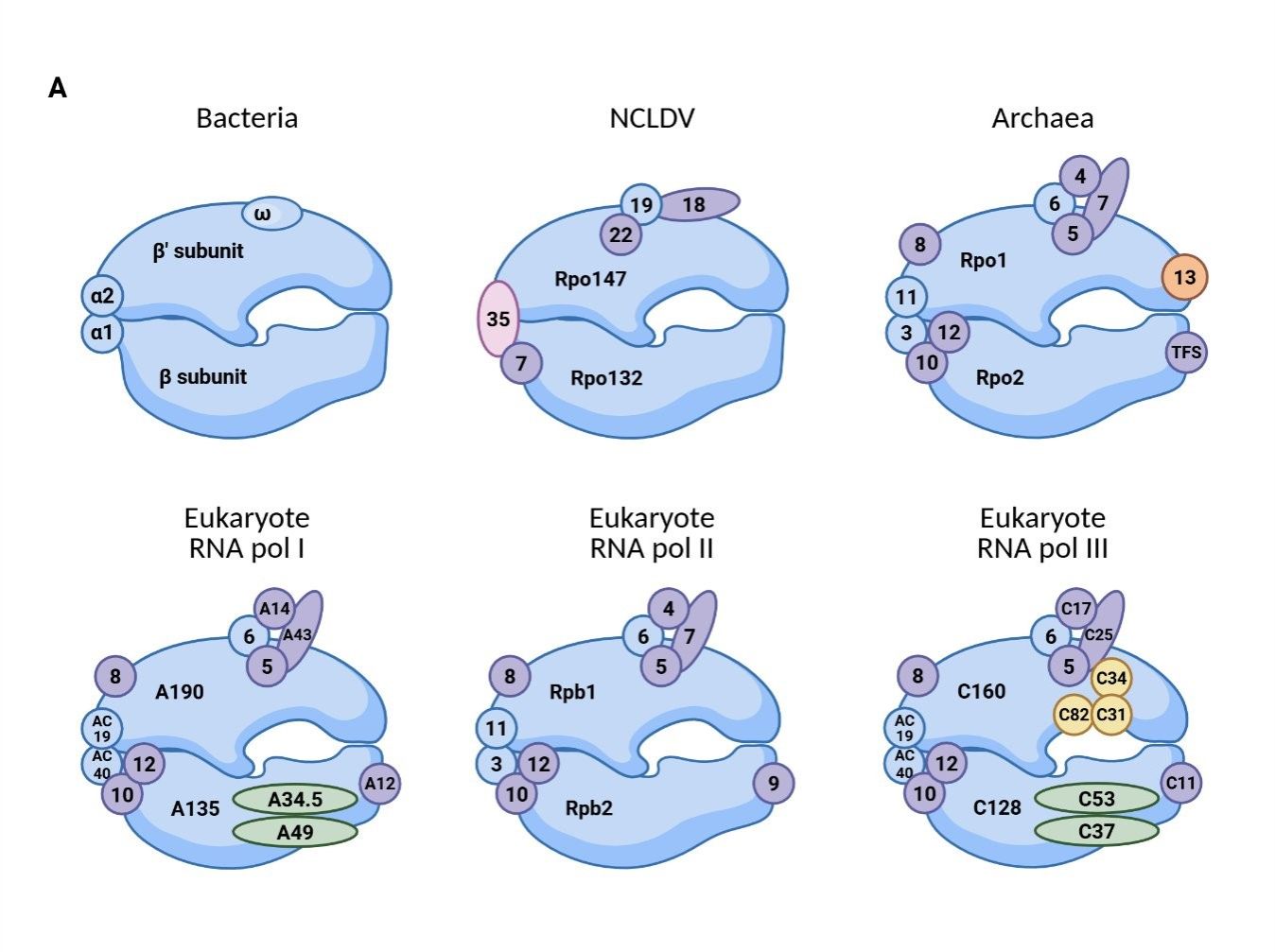
Figure: RNA polymerase (RNAP) composition and structure comparison across different domains of life.



