On February 5, 2026, Professor Q. Jason Niu's group published a research paper titled "Synthesis of Thin Film Composite Membranes via Acid-Assisted Interfacial Polymerization for Water Desalination" in Water Research. This study presents a novel strategy for fabricating high-performance thin film composite (TFC) membranes via acid-assisted interfacial polymerization (AAIP), achieving synergistic improvements in water permeance and salt rejection. Professor Q. Jason Niu is the corresponding author, and Jianquan Peng is the first author. Shenzhen University is the sole affiliation.
Fresh water scarcity is a significant global challenge, with reverse osmosis (RO) accounting for 69% of global desalination capacity. However, conventional TFC membranes based on planar monomers m-phenylenediamine (MPD) and trimesoyl chloride (TMC) have densely packed polymer chains that limit microporosity, making it difficult to simultaneously achieve high water permeance and high salt rejection. The research team proposed an innovative strategy using acid-assisted interfacial polymerization (AAIP) to successfully incorporate rigid and contorted amine monomers into polyamide membranes, thereby enhancing microporosity and narrowing pore size distribution.
The results show that the intrinsic rigidity of rigid and contorted monomers contributes to a narrower pore size distribution of the polyamide film, while their contorted geometry disrupts dense chain packing, thereby promoting microporosity. Furthermore, by carefully tuning the hydrophobicity of acid additives, the study demonstrates that acids with larger hydrophobic tails reduce interfacial tension and promote amine monomer enrichment at the water/hexane interface. This, in turn, enhances amine monomer supply at the interface, resulting in improved microporosity and significantly increased water permeance. The resulting TFC membrane achieves a high water permeance of 5.4 L m-2 h-1 bar-1 (270% of planar monomer-based membranes) with excellent NaCl rejection of 98.5%, outperforming most previously reported and commercially available TFC membranes.
This study comprehensively investigates the critical role of acid additives in the AAIP process, revealing the molecular mechanisms by which hydrophobic acids reduce interfacial tension and promote amine monomer interfacial enrichment. Through molecular dynamics simulations and density functional theory calculations, the research team systematically elucidated the effects of different sulfonic acids on interfacial behavior, providing a theoretical foundation for the design of high-performance TFC membranes. This work highlights the promising potential of AAIP in fabricating high-performance TFC membranes and paves the way for future development of IP-based membranes in molecular sieving applications.
This work was supported by the National Natural Science Foundation of China (NO. U2006230), the Science and Technology Planning Project of Shenzhen Municipality (JCYJ20210324095202008).
Paper link:https://doi.org/10.1016/j.watres.2026.125517
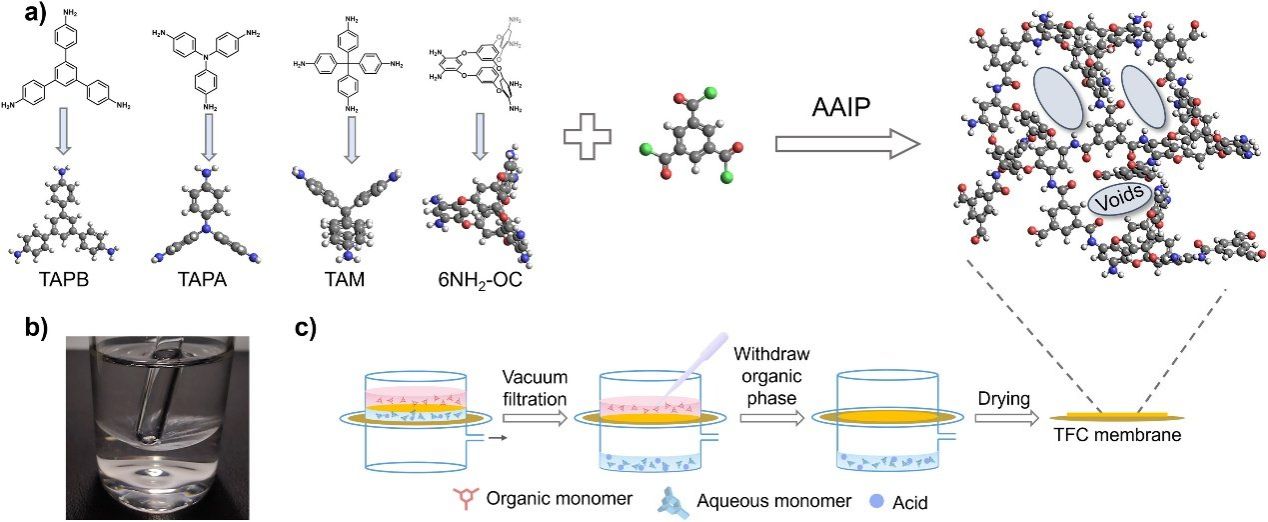
Figure 1. Schematic illustration of high-performance TFC membrane preparation via acid-assisted interfacial polymerization



