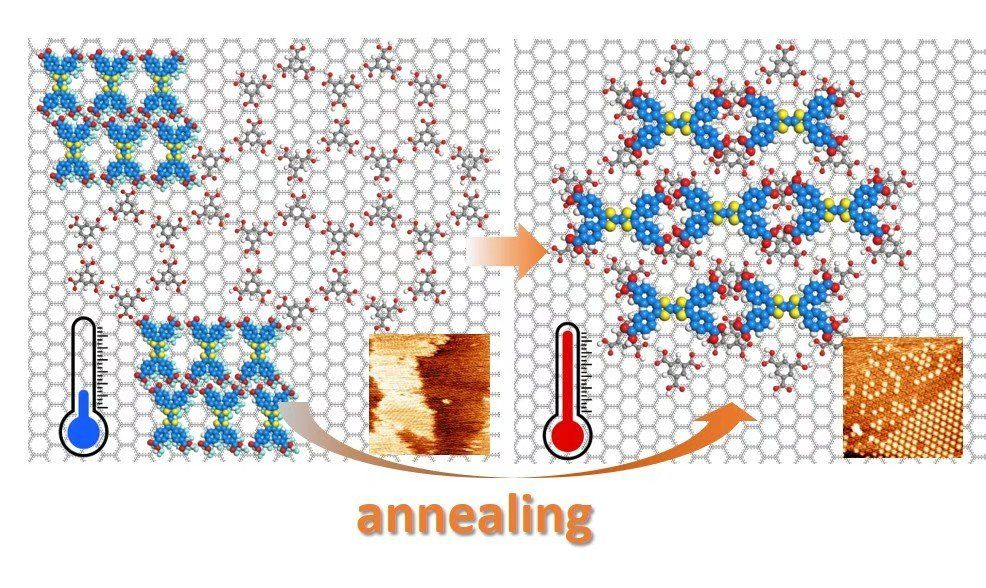
On January 13, 2026, the research group of Lee Shern-Long made new progress in the study of the regulation mechanism of surface supramolecular self-assembly. By introducing thermal stimulation, the research team achieved a controllable transformation of binary supramolecular systems from phase separation to synergistic co-crystallization structures at the liquid-solid interface. The relevant results were published in the Royal Society of Chemistry's flagship journal Chemical Science (Nature Index journal, CAS Category 1) under the title 'Thermal-mediated modulation of binary supramolecular self-assembly from phase separation to co-crystallization at the liquid–solid surface'. Chen Fang and He Jun are co-first authors of the paper, and Associate Professor Lee Shern-Long is the corresponding author.
The study used a host-guest system composed of terephthalic tricarboxylic acid (TMA) and tetrathiafulvalene (TTF) derivatives as a model. Scanning tunneling microscopy (STM) was employed to systematically investigate the effect of temperature on molecular adsorption behavior and the evolution of self-assembly structures. It was found that at room temperature, the binary system mainly exhibits phase separation structures; however, after thermal annealing, the system can transform into a thermodynamically more stable host-guest co-crystalline structure. With increasing annealing temperature, the system evolves between different polymorphs, exhibiting a clear temperature-dependent regulation pattern.
The competitive relationship between phase separation and co-crystallization is a key scientific issue in multi-component supramolecular systems. In previous studies, methods such as electric field regulation, solvent engineering, concentration adjustment, and template induction have been able to influence assembly results to some extent, but they often rely on specific systems or multiple external fields, with limitations in universality and controllability. This study shows that thermal stimulation, as a simple and effective external regulation method, not only enhances molecular migration ability and helps the system overcome kinetic energy barriers but also promotes the transition of the system from kinetically controlled to thermodynamically stable structures by reshaping the energy landscape of intermolecular and molecule-substrate interactions.
Combined with force field simulation calculations, the research team systematically analyzed hydrogen bonding, intermolecular interactions, and adsorption energy in different assembly structures. The experimental results are highly consistent with theoretical analysis. The study further reveals that even when the molecular sizes are not perfectly matched, binary systems can still achieve stable co-crystalline structures through thermal regulation, providing new insights into understanding the assembly mechanisms of complex supramolecular systems and constructing controllable molecular nanostructures.
This work was supported by the Guangdong Provincial Department of Science and Technology (Grant No. 2024A1515010482), the Student Project of IAS at Shenzhen University, and the Shenzhen University Nanoscience (Graduate Golden Course) Fund.
Original link: https://doi.org/10.1039/D5SC06698K