On January 5, 2026, Prof. Meng Li’s team from the Institute for Advanced Study (IAS) of Shenzhen University published a research paper titled “A pentose bisphosphate pathway of nucleotide degradation in Promethearchaeum syntrophicum” in Science China Life Sciences. Prof. Meng Li from the IAS is the corresponding author. Dr. Li Liu is the first author. Shenzhen University is the sole affiliation.
Asgard archaea have attracted significant attention due to their close phylogenetic relationship with eukaryotes and their encoding of numerous eukaryotic signature proteins. Although metagenomic studies have predicted their diverse metabolic potentials, the long-term absence of pure cultures has made physiological validation of these predictions an urgent necessity. This study focuses on the pentose bisphosphate pathway—a nucleotide degradation route that links nucleotide recycling to central carbon metabolism and is considered a relic of ancient heterotrophy.
Using Promethearchaeum syntrophicum MK-D1, the first Asgard archaeon isolated and cultivated in 2019, the research team systematically characterized three key enzymes of this pathway: nucleoside-5’-monophosphate phosphorylase, ribose-1,5-bisphosphate isomerase, and ribulose-1,5-bisphosphate carboxylase/oxygenase (RuBisCO). The experimental results demonstrate that all three enzymes are functionally active and capable of converting nucleoside monophosphates to 3-phosphoglycerate, confirming the presence of a functional pentose bisphosphate pathway in Asgard archaea.
Notably, the study revealed that adenosine monophosphate (AMP) acts as an allosteric activator, increasing the activity of ribose-1,5-bisphosphate isomerase by nearly 6-fold—a regulatory mechanism that likely reflects the evolutionary adaptation of this archaeon to energy-limited syntrophic environments. Furthermore, RuBisCO from P. syntrophicum exhibits significant oxygen sensitivity, consistent with the strictly anaerobic lifestyle of this organism. Through phylogenetic analysis of 296 Asgard archaeal genomes, the research team revealed that the distribution of pentose bisphosphate pathway genes in these archaea is modular and phylogenetically restricted, indicating that the pathway has undergone a complex evolutionary history involving gene loss and possible horizontal transfer (Figure 1).
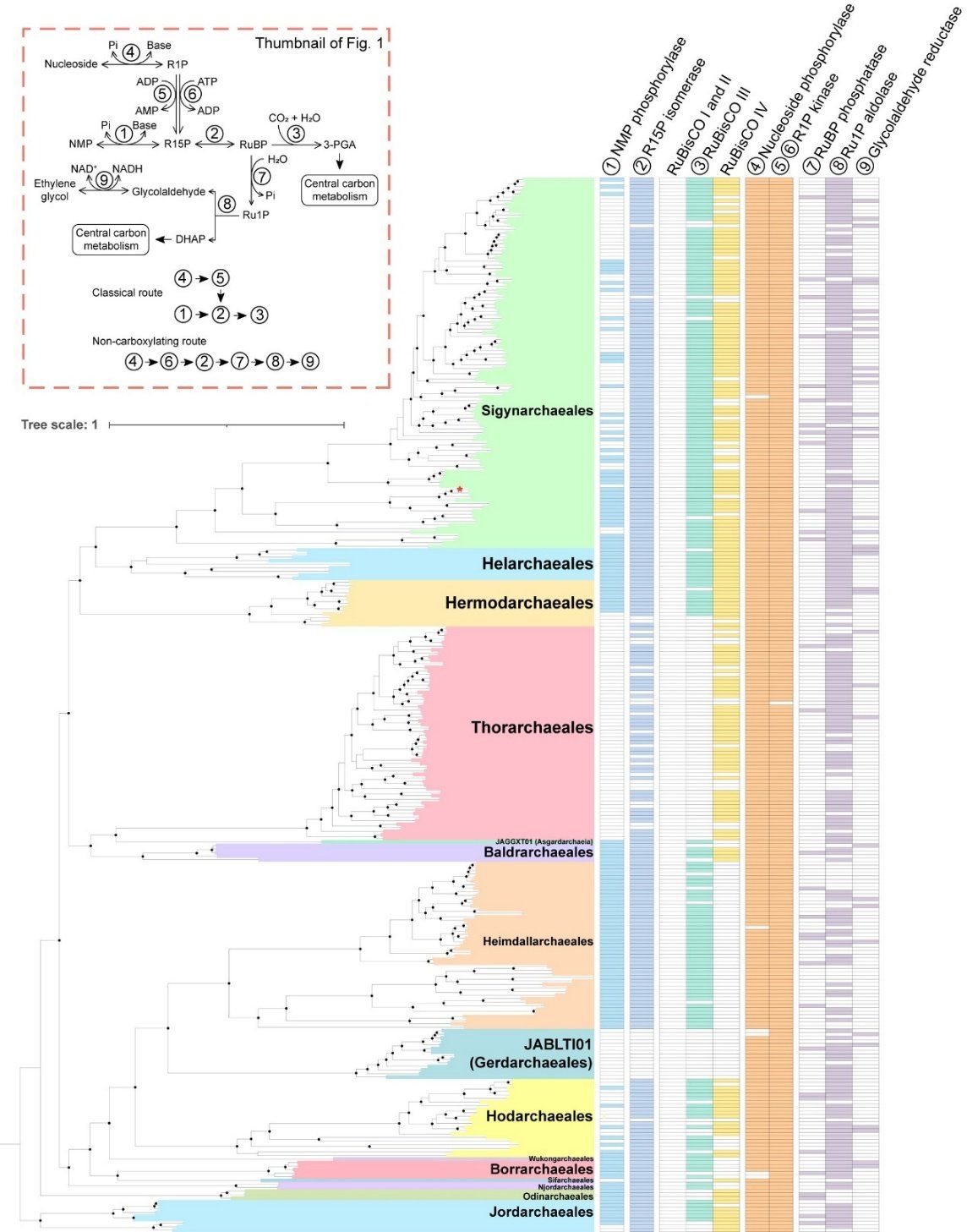
Figure 1. Phylogenetic distribution and metabolic potential of the pentose bisphosphate pathway in Asgard archaea
This study provides the first experimental evidence for the functional existence of the pentose bisphosphate pathway in Asgard archaea, expanding our understanding of their metabolic diversity and offering crucial molecular insights into early Earth energy and carbon cycles.
This work was supported by National Natural Science Foundation of China, Shenzhen Medical Research Fund, Guangdong Major Project of Basic and Applied Basic Research, Shenzhen University 2035 Program for Excellent Research, the Shenzhen University Special Funding Initiative and the Synthetic Biology Research Center of Shenzhen University.
Article: https://www.sciengine.com/SCLS/doi/10.1007/s11427-025-3201-4



