On March 20, 2026, the research group led by Professor Tailin Xu published a paper titled “Wearable ultrasound microneedle patch for on-demand and sustained gouty arthritis management” in npj Flexible Electronics. By developing a wearable ultrasound microneedle patch system, this study is expected to revolutionize traditional drug delivery methods. The core objective of this research is straightforward: to address the contradiction in gout treatment—the need for rapid drug administration during acute episodes and sustained low-dose delivery during chronic phases—while enabling drug delivery into deep tissues. Professor Tailin Xu is the corresponding author, team member Shuxin Zhang is the first author, and Shenzhen University is the sole affiliated institution.
Gout, an ancient disease often referred to as the “disease of kings,” continues to afflict tens of millions of patients worldwide. When monosodium urate (MSU) crystals deposit in the joint cavity, they not only cause excruciating pain—patients suffer from joint redness, swelling, and limited mobility during acute episodes—but also face long-term threats such as joint deformity and bone erosion during chronic phases. Traditional oral or injectable drug delivery methods have notable shortcomings: drugs must be absorbed through the gastrointestinal tract and metabolized by the liver, resulting in slow onset of action and potential systemic side effects. Although existing microneedle-based transdermal drug delivery technologies are painless and convenient, most rely on passive diffusion or stimulation by the body’s internal environment, making it difficult to flexibly control drug release rates and ensure effective penetration into deep tissues. The research team reported a fully integrated wearable drug delivery system that combines a flexible and stretchable ultrasound-responsive microneedle patch with a portable, Bluetooth-programmable ultrasound driver. This system enables on-demand drug release, allowing for rapid delivery within 10 minutes or sustained release for up to 50 hours. Moreover, ultrasound-induced directional acoustic streaming at the microneedle tips significantly enhances transdermal penetration. As a proof of concept, this system achieved precise delivery of colchicine, producing rapid anti-inflammatory and anti-swelling effects in acute gouty arthritis, as well as long-term therapeutic and preventive efficacy in chronic gouty arthritis. This work establishes a controllable and versatile strategy for personalized transdermal therapy, with potential applications across diverse diseases and stages of progression.
This research was financially supported by the Shenzhen Science and Technology Program (JCYJ20240813142503006), the Synthetic Biology Research Center of Shenzhen University, and the Key Laboratory of Marine Microbiome Engineering of Guangdong Higher Education Institutes (2024KSYS011).
Original link:https://www.nature.com/articles/s41528-026-00554-4
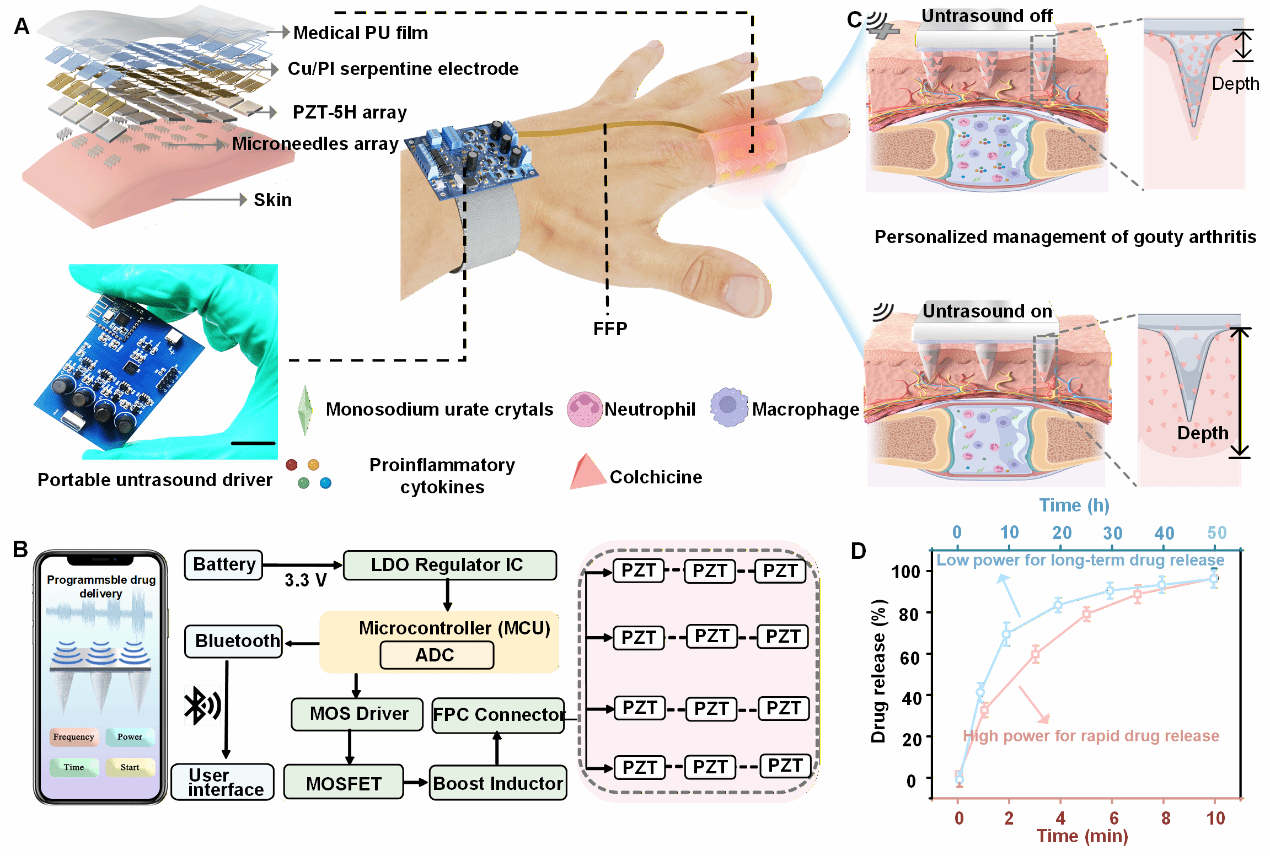
Figure 1. Schematic diagram of the fully integrated wearable drug delivery system for gouty arthritis management



