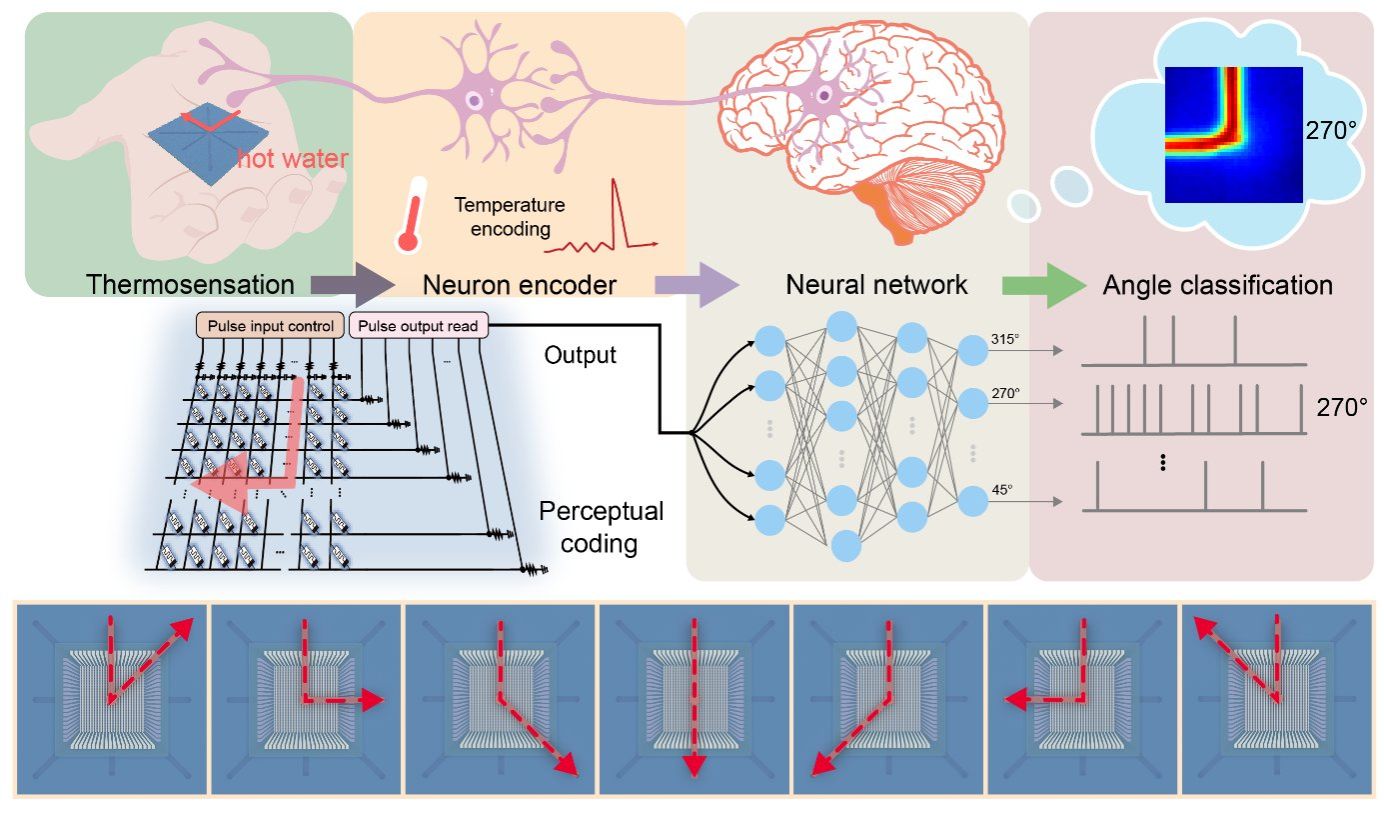
On February 26, 2026, Zhou's team published a paper entitled "Intelligent Temperature Monitoring for Microfluidic System Using Mo0.5W0.5S2-Polymer Composite Based Memristive Sensory Neurons" in Advanced Functional Materials. This research paper explores memristive sensory neuron. Hang Li is the first author. Ye Zhou and Guanglong Ding are the corresponding authors.
Precise and intelligent temperature monitoring in microfluidic systems is significant for improving efficiency and reducing costs across various applications in biology, chemistry, and medicine. Biomimetic sensing technologies integrated with on-chip pulse encoding offer a promising strategy by directly capturing temperature signals and encoding them for further processing, while providing advantages including high-density integration and low energy consumption. The threshold-switching memristor (TSM), configured to simulate leaky integrate-and-fire (LIF) neurons, is particularly appealing as it combines sensing and encoding functionalities within a single device. However, achieving high-performance TS characteristic and temperature sensitivity in TSM-based LIF neurons remains a challenge. Here, a temperature-responsive TSM is presented with low operating voltage by using Mo0.5W0.5S2 nanosheets (NSs)-polymer composite as resistive switching materials. The Mo0.5W0.5S2 NSs act as an “intermediate waystation” at the composite during the Ag ion migration process, facilitating the formation of conductive filaments and decreasing the operating voltage. A thermal flow angle recognition system is developed by integrating a 40 × 40 memristor array onto the microfluidic chip surface. With the assistance of a spiking neural network, seven categories of thermal flow angles can be successfully identified with a high accuracy of 99.75%, indicating the TSM's great potential in microfluidic chip temperature monitoring. The research was supported by the National Natural Science Foundation of China, the Basic and Applied Basic Research Foundation of Guangdong Province, the Science and Technology Innovation Commission of Shenzhen, RSC Sustainable Laboratories Grant, the State Key Laboratory of Radio Frequency Heterogeneous Integration (Independent Scientific Research Program), etc.
Original link:https://advanced.onlinelibrary.wiley.com/doi/full/10.1002/adfm.20252152