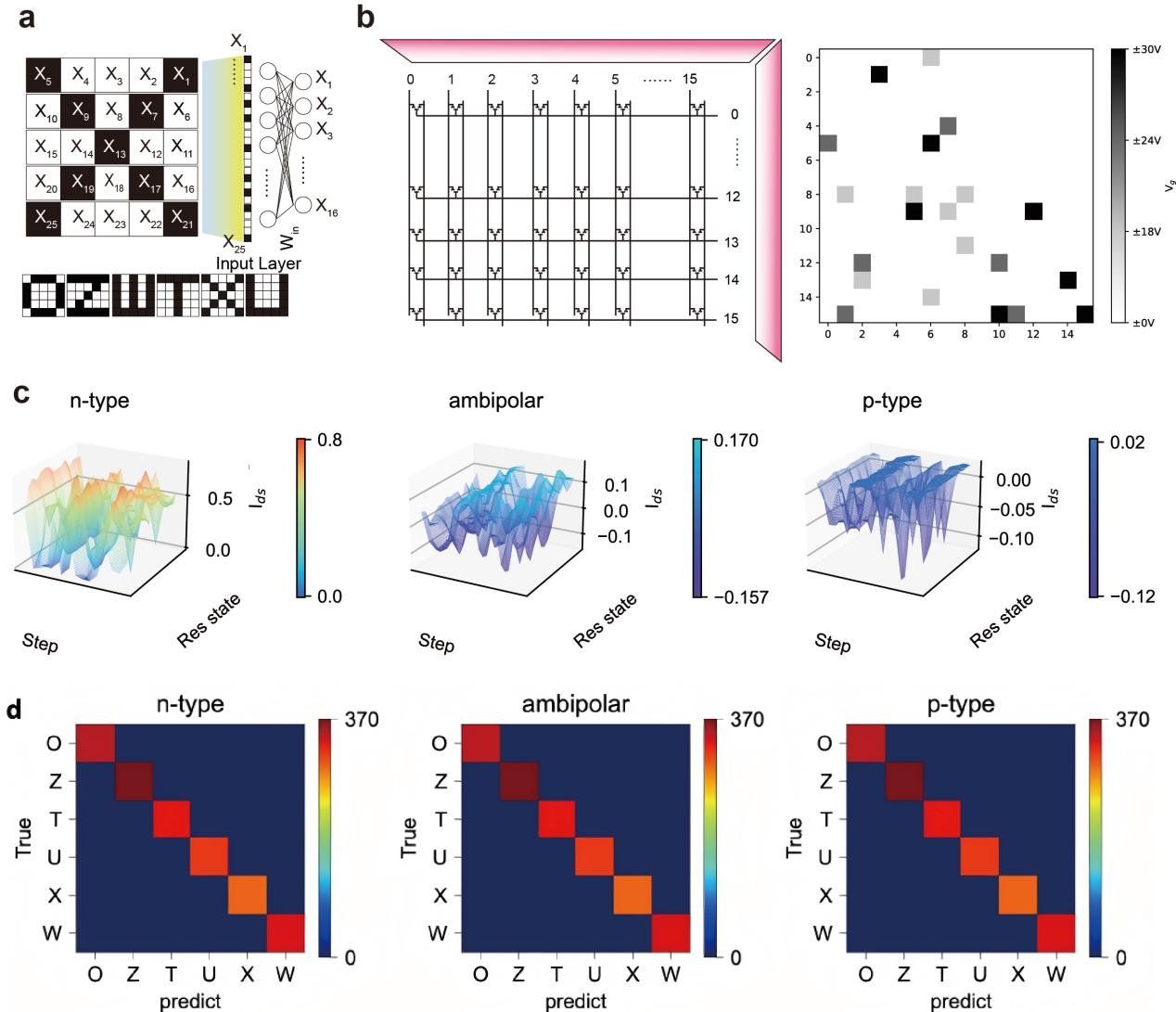
On February 28, 2026, Zhou's team published a paper entitled "Physical echo state network based on the nonlinearity and dynamic response of ambipolar heterostructure transistors" in Nature Communications. This research paper explores ambipolar heterostructure transistors for physical echo state network (ESN). Wen-Ming Zhong is the first author. Ye Zhou is the corresponding author.
In the field of neuromorphic computing, time-series prediction poses a significant challenge to recurrent neural network architectures, often requiring task-specific customization that limits the development of general-purpose computing platforms. In this work, we implement a physical ESN using ambipolar organic-inorganic heterostructure transistors to form its reservoir layer. Leveraging the ambipolar nature of the transistor, its variable-resistance region enables sparse matrix operations, while the saturation region provides tanh-like nonlinearity, making it well-suited for implementing both synaptic weighting and neuronal activation in an ESN. Additionally, its dynamic response naturally introduces temporal attributes. Thus, it can serve as a neuromorphic computing model for time-series tasks. Without the involvement of dynamic mechanisms, it is capable of performing image recognition, time-series prediction, and multimodal recognition tasks. When dynamic mechanisms are incorporated, the model achieves an accuracy of 96.98% on the MNIST handwritten digit dataset and 86.67% on the Fashion-MNIST dataset. This work offers a neuromorphic computing architecture, providing insights for tasks such as nonlinear mapping and time-series prediction. The research was supported by the Basic and Applied Basic Research Foundation of Guangdong Province, the Science and Technology Innovation Commission of Shenzhen, the State Key Laboratory of Radio Frequency Heterogeneous Integration (Independent Scientific Research Program), etc.
Original link:https://www.nature.com/articles/s41467-026-70171-2