On March 30, 2026, the research team led by Dr. Sheng Yan from the Institute for Advanced Study, Shenzhen University, published a paper entitled “A Pump-Free, Magnetorheological-Elastomer-Driven Oscillatory Microfluidic Device for Cell Manipulation” in Analytical Chemistry (IF = 6.7, CAS Q1 TOP, Nature Index journal). Dr. Sheng Yan, a researcher from the Institute for Advanced Study, Shenzhen University, is the corresponding author. Jialin Wu, a PhD student at Monash University, is the first author. Wenju Liu and Huijin Wang, master’s students at the Institute for Advanced Study of Shenzhen University, undergraduate student Fankun Zeng, and Yong Liu, a PhD student at Southeast University, also contributed to this work. This research was supported by the National Natural Science Foundation of China, the Pearl River Talent Plan, the Shenzhen University–Taiwan Tech Joint Project, and the Shenzhen University Excellent Research Program. In addition, the team of Researcher Shanshan Xu at the Institute for Advanced Study, Shenzhen University, and the Department of Clinical Laboratory at Peking University Shenzhen Hospital provided biological sample support for this study.
Oscillatory flow in microfluidics has important applications in particle focusing, cell separation, and mechanobiology research. However, existing oscillatory microfluidic systems usually rely on external pumps, valves, or complex on-chip actuation units, which limits their portability, biocompatibility, and practical applications. Developing an oscillatory microfluidic platform with a simple structure, easy fabrication, and no need for external precision driving is therefore of great significance for advancing pump-free microfluidic technologies.
The Sheng Yan Research Group developed a pump-free oscillatory microfluidic device driven by a pump-Free, magnetorheological-elastomer-driven oscillatory microfluidic device (PMOM). In this device, a rotating permanent magnet periodically drives the deformation of a magnetorheological elastomer membrane inside the chip, thereby generating reciprocating oscillatory flow in a straight microchannel. The team first systematically investigated the effects of PEO concentration, oscillation time, and oscillation frequency on particle focusing behavior, revealing the migration rule of particles toward the channel centerline and sidewalls in oscillatory viscoelastic flow. On this basis, the platform achieved nanoscale particle focusing at an ultralow blockage ratio of 0.0047, which is about 93% lower than the conventional threshold of 0.07 in traditional unidirectional inertial microfluidics. In addition, the device enabled the focusing and enrichment of extracellular vesicles (EVs) of about 270 nm in a relatively large straight microchannel, demonstrating its capability for manipulating nanoscale biological particles.
Furthermore, the Sheng Yan Research Group extended this platform to biological sample manipulation, successfully achieving size-dependent separation of blood cells and cancer cells, as well as low-shear platelet activation without chemical agonists. In mixed samples, blood cells were highly focused at the channel center, while cancer cells (colorectal cancer cells and breast cancer cells) migrated toward the sidewalls, demonstrating effective separation performance. This work shows that the pump-free oscillatory microfluidic strategy not only combines the advantages of simple structure, low cost, and good portability, but also provides a new technical platform for cell separation, nanoscale vesicle enrichment, and studies of mechanical microenvironments.
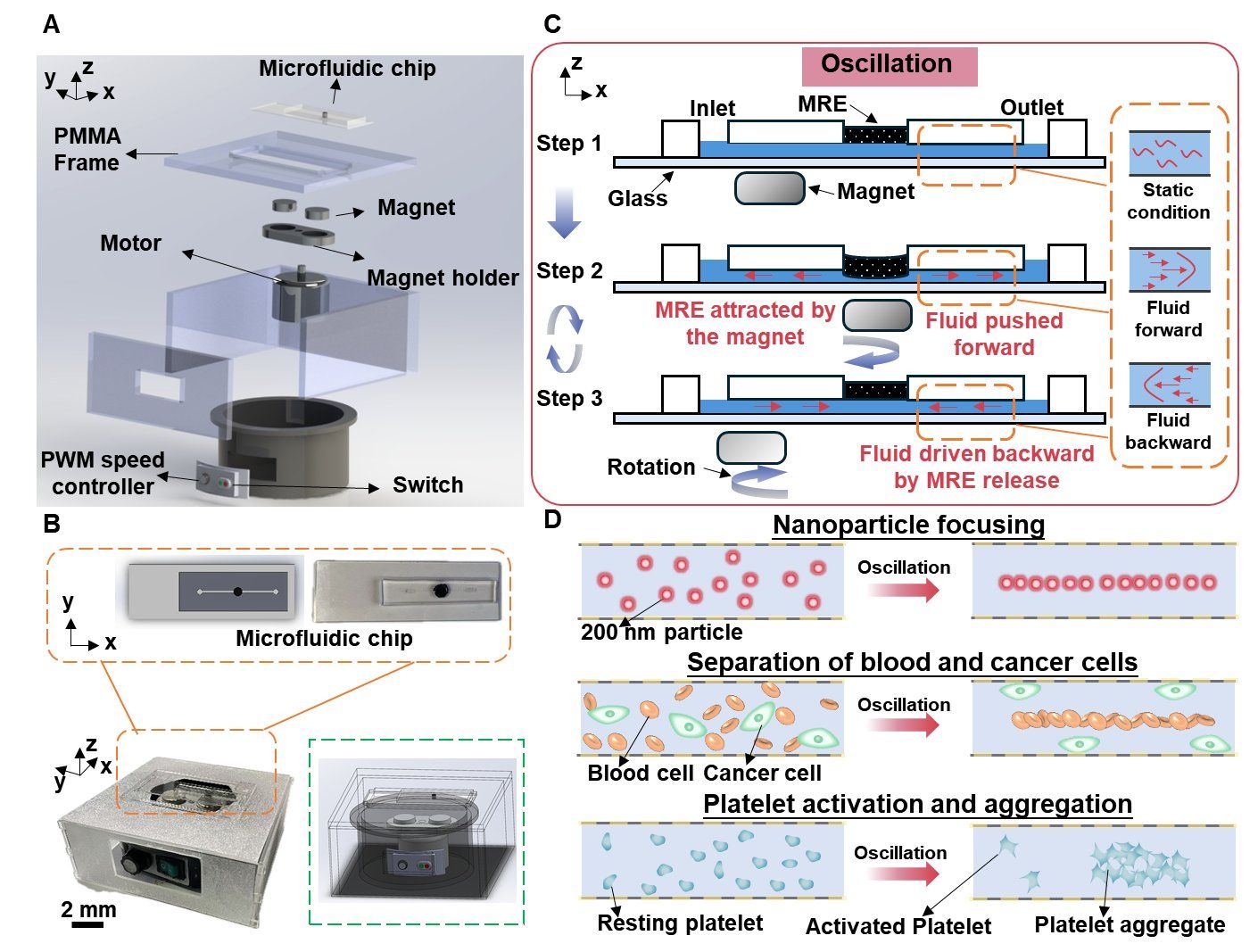
Figure 1 Structural design, working principle, and application demonstration of PMOM device.
Link: https://pubs.acs.org/doi/10.1021/acs.analchem.6c01227



