On April 3, 2026, Prof. Meng Li’s team from the Institute for Advanced Study (IAS) of Shenzhen University published a research paper titled “From field metagenomes to mutant genomes: coevolution of cyanophages and Synechococcus in estuarine ecosystems” in Environmental Science & Technology. Focusing on four representative estuarine ecosystems in China, the study combined environmental metagenomic analyses with laboratory evolution experiments to systematically characterize the interactions between cyanophages and Synechococcus and to elucidate their coevolutionary features from both natural and experimental perspectives. Professor Meng Li of Shenzhen University and Professor Qinglu Zeng from The Hong Kong University of Science and Technology are the co-corresponding authors. PhD student Yisha Tan is the first author. The work was carried out through a collaboration between Shenzhen University and The Hong Kong University of Science and Technology.
Cyanobacteria are among the most important groups of photosynthetic microorganisms in aquatic ecosystems. Among them, Synechococcus is widely distributed in marine and estuarine environments and plays a key role in biogeochemical cycles such as the carbon cycle. Interactions between cyanophages and their cyanobacterial hosts have become an important model for studying ecology and evolution. Although the distribution and functions of cyanophages in marine environments have received considerable attention, estuarine ecosystems are characterized by salinity mixing, strong nutrient fluctuations, and pronounced seasonal changes. As a result, the diversity of cyanophages in these environments, as well as their interaction and adaptive mechanisms with hosts, remain insufficiently understood. In this study, the team analyzed 42 metagenomic samples collected from four estuaries in China and assembled a total of 83 cyanophage genomes. They found that these estuarine cyanophages carried an abundant repertoire of auxiliary metabolic genes (AMGs), suggesting a greater potential for environmental adaptation and host regulation. At the same time, the researchers used the representative cyanobacterial strain Synechococcus WH7803, which is widely distributed in coastal estuarine waters and the surface ocean, as their experimental model. Through laboratory evolution experiments, they obtained 18 phage-resistant Synechococcus mutants and performed whole-genome sequencing analyses on them (Figure 1). The results showed that, during resistance to cyanophage infection, the host repeatedly targeted specific functional loci. In particular, mutations in the rfbA gene, which is associated with carbohydrate metabolism, and the cpeT gene, which is involved in photosynthetic energy transfer, were found not only in the phage-resistant mutants generated in the laboratory, but also in assembled cyanobacterial genomes reconstructed from environmental metagenomes. These findings indicate that these genes may represent key mutational targets for Synechococcus adaptation to cyanophage-driven selective pressure in estuarine environments.
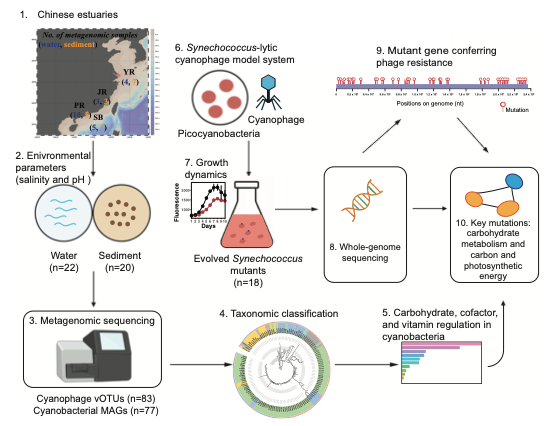
Figure 1. Coevolution of cyanophages and Synechococcus in estuarine ecosystems.
By integrating environmental metagenomic samples with laboratory evolution experiments, this study provides new mechanistic evidence for understanding the interactions and evolutionary dynamics between cyanophages and Synechococcus in estuarine ecosystems. This work not only expands our knowledge of viral diversity and functional potential in estuaries but also offers a new perspective on microbial community stability, the maintenance of genetic diversity, and material cycling in estuarine ecosystems. This work was supported by National Key Research and Development Program of China, National Natural Science Foundation of China, Guangdong Major Project of Basic and Applied Basic Research, Shenzhen University 2035 Program for Excellent Research, the Shenzhen University Special Funding Initiative and the Synthetic Biology Research Center of Shenzhen University, Research Grants Council of Hong Kong, and Hetao Shenzhen-Hong Kong Science and Technology Innovation Cooperation Zone..
Article: https://doi.org/10.1021/acs.est.5c12277.



