On April 20, 2026, Professor Meng Li’s team published their paper, A seven-year metagenomic genome catalogue of mangrove and mudflat sediments from the Futian Reserve, China, online in Scientific Data. Professor Meng Li is the corresponding author, Dr. Yan-Ling Qi is the first author, and Shenzhen University is the sole affiliated institution of the study.
Focusing on the Futian Mangrove National Nature Reserve in Shenzhen, the research team established a seven-year sediment metagenomic resource. A total of 65 sediment samples were collected between 2017 and 2023, covering paired habitats of mangrove forest and adjacent mudflat, as well as multiple sediment depths. Sequencing generated approximately 5.3 Tb of data, from which 6,922 metagenome-assembled genomes (MAGs) were reconstructed. After dereplication, 3,404 representative MAGs were obtained, including 336 archaeal MAGs and 3,068 bacterial MAGs. Phylogenetic analysis showed that this resource spans 13 archaeal phyla and 69 bacterial phyla, revealing the rich and extensive microbial diversity in Futian mangrove and mudflat sediments (Figure 1). Notably, many lineages still lack formal taxonomic names, suggesting that this ecosystem harbors abundant potential novel taxa and underexplored microbial genetic resources.
The core value of this study lies in the construction of a standardized, time-resolved genome catalogue of sediment microorganisms from a mangrove wetland ecosystem, together with the public release of raw sequencing data, assembled genomes, and detailed sample metadata. This resource will provide important support for future studies in coastal wetland microbial ecology, comparative genomics, environmental functional mining, and ecological restoration assessment. It also establishes a long-term data foundation for further understanding the ecological functions of mangrove “blue carbon” systems and their microbial drivers. This work was supported by the Guangdong Major Project of Basic and Applied Basic Research, the National Natural Science Foundation of China, the Shenzhen University 2035 Program for Excellent Research, the Shenzhen University Special Funding Initiative, the General Program of the Shenzhen Natural Science Foundation, the Synthetic Biology Research Center of Shenzhen University, and the Intelligent Computing Center of Shenzhen University.
Article: https://www.nature.com/articles/s41597-026-07291-3
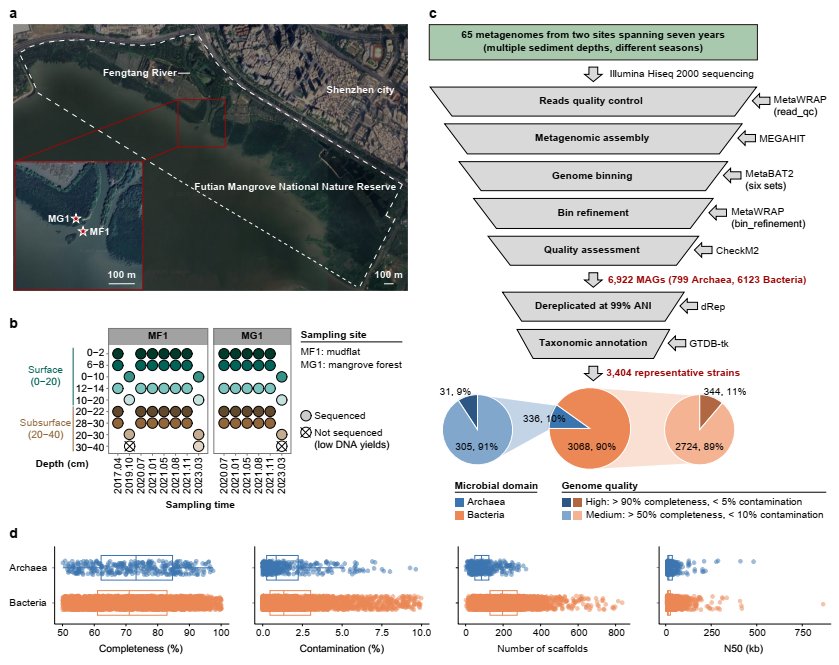
Figure 1. Overview of the seven-year metagenomic dataset from mangrove and adjacent mudflat sediments in Futian, Shenzhen



