1. Breaking the strength-dendrite paradox via cation-anion synergy to achieve spherical lithium deposition
The team published a paper titled “Breaking the strength-sendrite paradox in Polymer Electrolytes: Spherical Lithium Deposition via Redox-Active Fe–O/Cl Centers” in Chemical Science. This work put forward a lithium deposition regulation strategy based on cation-anion synergistic effects. By constructing redox-active Fe–O/Cl centers, the research realize uniform spherical lithium plating and effectively inhibit lithium dendrite propagation. Though the as-fabricated PEO-based electrolyte only exhibited a modulus of 3.1 MPa, far lower than the 30.8 MPa of unmodified PEO electrolyte, it possessed superior dendrite resistance. The critical current density of the electrolyte was elevated to 2.8 mA cm⁻², and Li||Li symmetric cells and Li||LiFePO₄ full cell demonstrate outstanding long-cycle stability. The Institute for Advanced Study, Shenzhen University serves as the primary affiliation; Ting Zhang from Shenzhen University is the first author, and Dr. Ruo Zhao acts as the corresponding author.
Original link: https://pubs.rsc.org/sc/article/doi/10.1039/d6sc04034a/1276542/
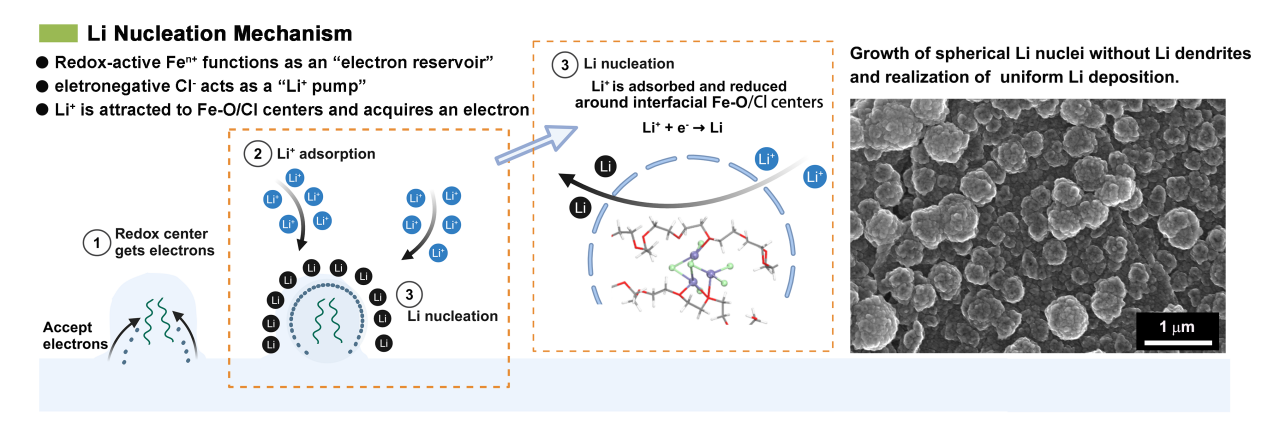
Figure 1. Schematic diagram of spherical lithium deposition regulated by redox-active Fe–O/Cl centers
2. MIL-88B-NH₂(Fe) fiber-reinforced solid polymer electrolyte with interfacial electrostatic shielding for dendrite suppression
In Small Structures, the group released the paper “MIL-88B-NH₂(Fe)-Based Fiber-Reinforced Polymer Electrolytes for Li-Metal Batteries”. The study developed an electrospun fiber-reinforced solid polymer electrolyte based on MIL-88B-NH₂(Fe) for high-performance lithium metal batteries. The fibrous backbone facilitates lithium salt dissociation and anion immobilization, simultaneously boosting ionic conductivity and lithium-ion transference number. Moreover, metal nodes of the MOF homogenizes the electric field via electrostatic shielding and durably restrain lithium dendrite growth. Coin-type Li||LiFePO₄ full cells deliver stable long-cycle performance at high rates of 2.0 C and 3.0 C. The pouch cells feature excellent mechanical flexibility and negligible temperature rise under extrusion and nail penetration tests without thermal runaway risks, offering a viable path toward safe, long-cycle and practically applicable lithium metal batteries. The Institute for Advanced Study, Shenzhen University is the primary affiliation, with Researcher Ruo Zhao as the corresponding author.
Original link: https://onlinelibrary.wiley.com/doi/full/10.1002/sstr.202500896
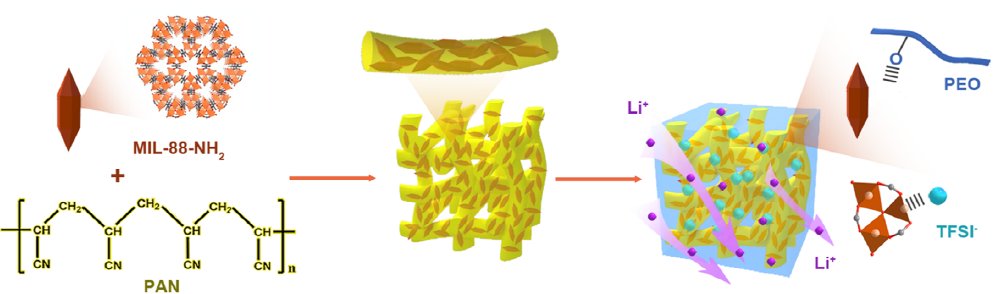
Figure 2. Illustration of fiber-reinforced composite polymer electrolyte
3. Defective MOF synchronously modulates electronic structure and confined active sites for accelerated polysulfide catalysis
The team published another paper titled “Regulating Electronic Structure and Confinement-Induced Site Densification in Defective MOF for Boosted Polysulfide Catalysis in Lithium–Sulfur Batteries” in Small Methods. The researchers fabricated defective MOFs via thermal induction to simultaneously tune the electronic configuration and optimize confined active sites. The dual effects strengthen polysulfide adsorption, accelerate electrode redox reactions, and mitigate the polysulfide shuttle effect. Li-S cells equipped with this catalytic material exhibit favorable cycling performance, and in-situ XRD characterization verifies the fully reversible sulfur conversion pathway. This study establishes a universal defect engineering strategy for designing high-performance materials for Li-S batteries. Researcher Ruo Zhao is the corresponding author.
Original link: https://onlinelibrary.wiley.com/doi/full/10.1002/smtd.202502136
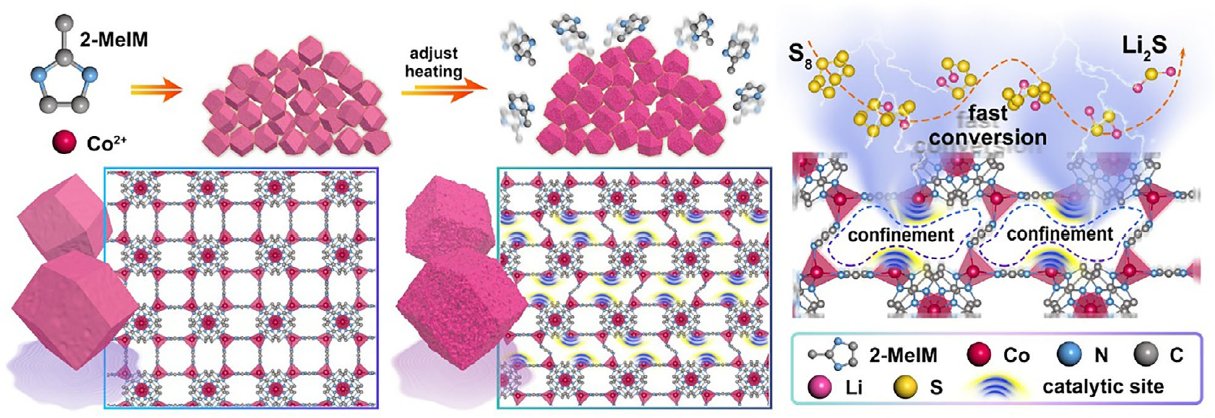
Figure 3. Schematic of defective MOF applied in Li-S batteries



