On July 12, 2026, the research team led by Assistant Professor Haibing Xie, in collaboration with Prof. Edgardo Saucedo’s group at the Universitat Politècnica de Catalunya (UPC), published a study in ACS Photonics. The paper, titled “Holistic defect passivation by a dual-additive strategy enables efficient and stable wide bandgap perovskite solar cells and perovskite/CZTSSe tandem solar cells,” features Dr. Prabakaran Selvaraj and Dr. Yuancai Gong as the co-first authors. Assistant Professor Haibing Xie and Prof. Edgardo Saucedo serves as the corresponding authors, with the Institute for Advanced Study at Shenzhen University and Barcelona East School of Engineering at UPC designated as the primary affiliations.
Wide bandgap (1.65-1.7 eV) inverted perovskite solar cells (WBG PSCs) are crucial top subcells of perovskite-based tandem solar cells (TSCs) to achieve next-generation super-high-efficiency photovoltaic devices. The challenges in WBG PSCs include phase instability and non-radiative recombination at the bulk and interfaces. To address these issues, a dual-additive strategy was developed utilizing functional molecules such as (aminomethyl)phosphonic acid (AMP) and 4-chlorobenzenesulfonate (4Cl-BZS) to synergistically improve the crystal quality and passivates interface defects of WBG PSCs. Specifically, AMP mainly settles at the bottom interface of the perovskite, leading to reduced hole-trap density and improved band alignment of hole transporting layer/perovskite. In contrast, 4Cl-BZS is prone to distribute on the surface of perovskite films, reducing the electron-trap density at the perovskite/C60 interface by passivating undercoordinated Pb2+ ions. Consequently, the holistic defect passivation in the bulk and interfaces enables WBG PSCs with a champion power conversion efficiency (PCE) of 23.05%. The devices can retain 80% of their initial efficiency for 800 h after maximum power point tracking under continuous one sun illumination and 1300 h after annealing at 85 ◦C in N2, respectively. Moreover, based on this dual-additive strategy, four-terminal (4-T) perovskite/CZTSSe TSCs achieved a record PCE of 24.43%. This study offers crucial insights into the dual-additive strategy for the holistic defect passivation and the development of efficient and stable WBG PSCs and perovskite-based TSCs.
This research was supported by the Shenzhen Pengcheng Peacock Program Startup Fund and the Shenzhen University High-Level University Construction Phase II Startup Fund (QNJS-2022012).
Original article link: https://pubs.acs.org/doi/10.1021/acsphotonics.6c00963
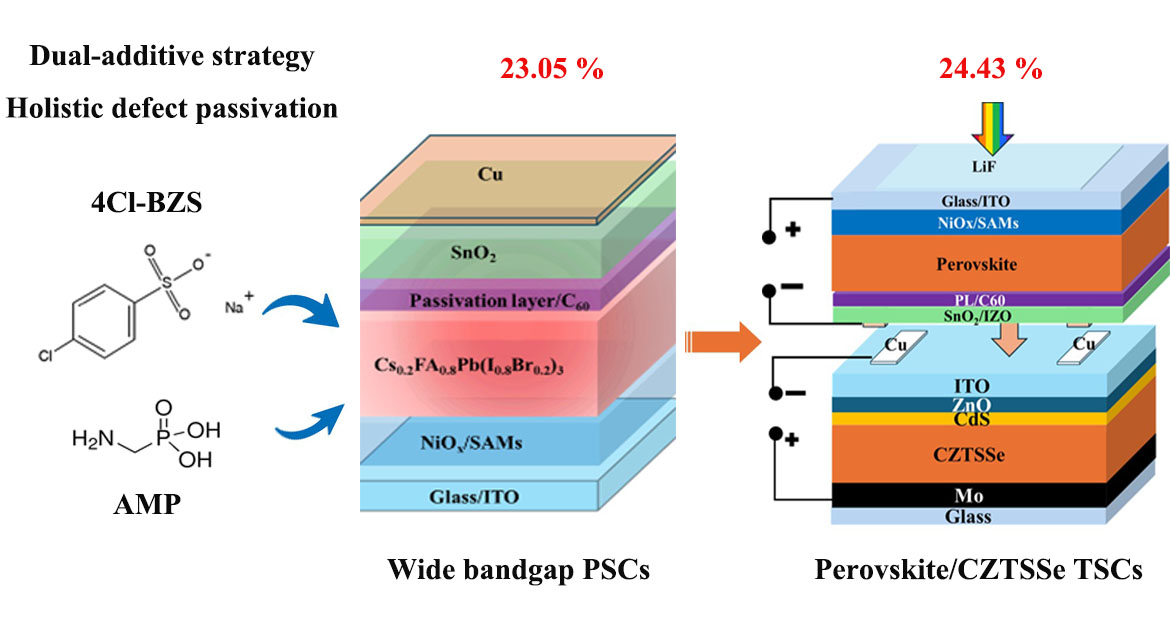
Fig. 1 Holistic defect passivation by a dual-additive strategy enables efficient and stable wide bandgap perovskite solar cells and record perovskite/CZTSSe tandem solar cells



