On June 9, 2026, the research groups of Assistant Professor Haibing Xie and Associate Professor Shern-Long Lee published a review paper on flexible perovskite solar cells (FPSCs) in Chemical Engineering Journal. PhD candidate Muhammad Sajid is the first author of the paper. Assistant Professor Haibing Xie and Associate Professor Shern-Long Lee serve as the co-corresponding authors, with the Institute for Advanced Study at Shenzhen University designated as the sole corresponding affiliation.
The development of FPSCs has revolutionized the photovoltaic industry by integrating exceptional light absorption with mechanical flexibility and low-cost production methods. In just a decade, FPSCs have achieved remarkable power conversion efficiencies, ranging from 2.62% to 26.2%, highlighting their potential as dependable energy sources in the near future. This review examines the latest advancements in FPSC technology, with a focus on new flexible substrates, charge-transport layers, and perovskite materials. Various flexible substrates, such as polymers, ultrathin metals, flexible glasses, and innovative biomass-based materials, have been studied for their mechanical strength and environmental stability. The review also covers advancements in charge-transport materials, including electron and hole transport layers, as well as self-assembled monolayers (SAMs), emphasizing their contributions to interface passivation, enhanced charge extraction, and overall device longevity. Fabrication techniques, including roll-to-roll and slot-die coating, which are crucial for large-scale production and commercialization, are also discussed. Lastly, the review addresses persistent challenges, including mechanical wear, interfacial instability, and environmental degradation. In conclusion, this article provides an overview of the progress in FPSC technology, demonstrating how improvements in substrate selection, interface optimization, and scalable manufacturing processes are vital for transitioning FPSCs from experimental prototypes to commercially viable and durable photovoltaic systems.
This research was supported by the Shenzhen Pengcheng Peacock Program Startup Fund, the Shenzhen University High-Level University Construction Phase II Startup Fund (QNJS-2022012), the Guangdong Science and Technology Department project (2024A1515010482), and the 2026 Joint Research Project between SZU-NTUT.
Original article link: https://www.sciencedirect.com/science/article/abs/pii/S1385894726056767
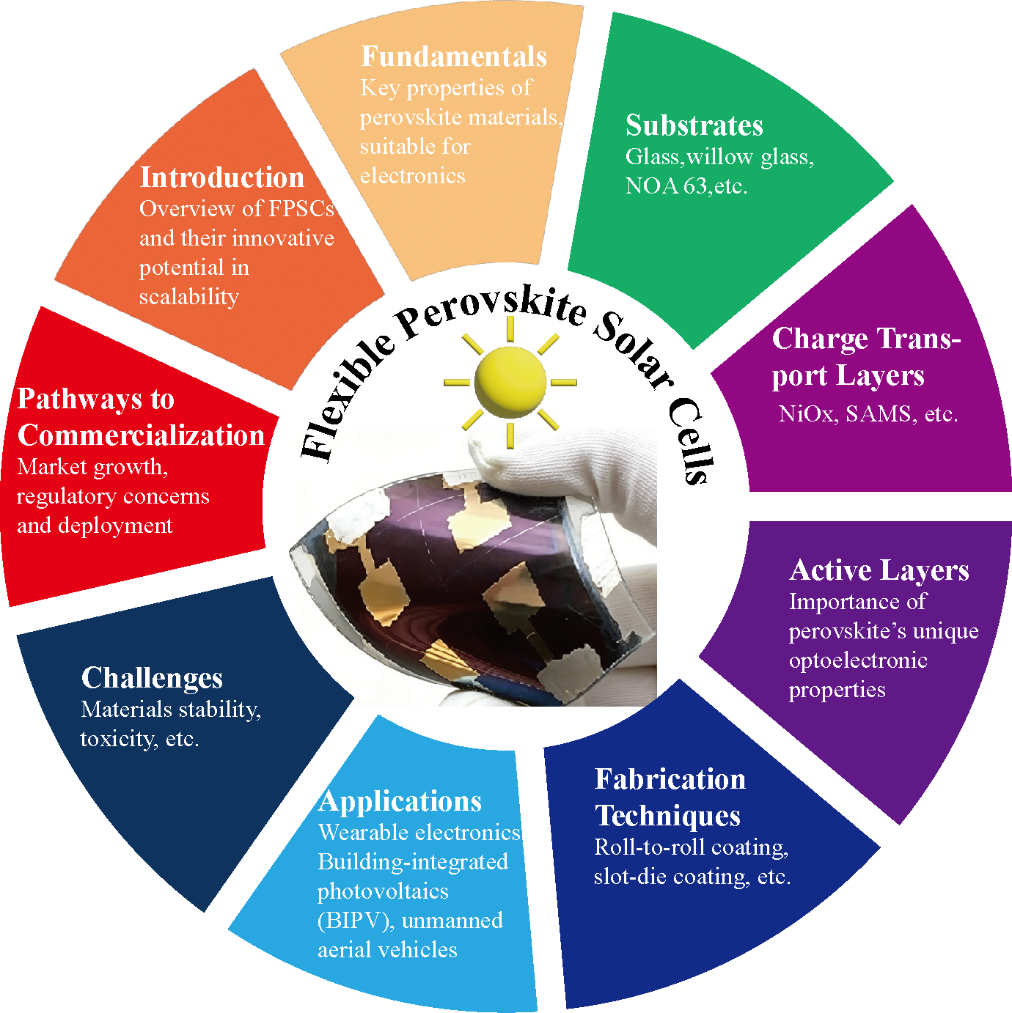
Fig. 1 Innovations in functional layers of flexible perovskite solar cells toward efficient and commercially viable photovoltaics



