On August 21, 2026, the research group led by Associate Professor Shern-Long Lee published a review article entitled “Recent advances in carbon-based materials for hole transport layer-free perovskite solar cells: A mini review” in the international academic journal Chinese Chemical Letters. Ph.D. student Muhammad Sajid is the first author, Associate Professor Shern-Long Lee is the sole corresponding author, and the Institute for Advanced Studies, Shenzhen University, is the sole corresponding affiliation.
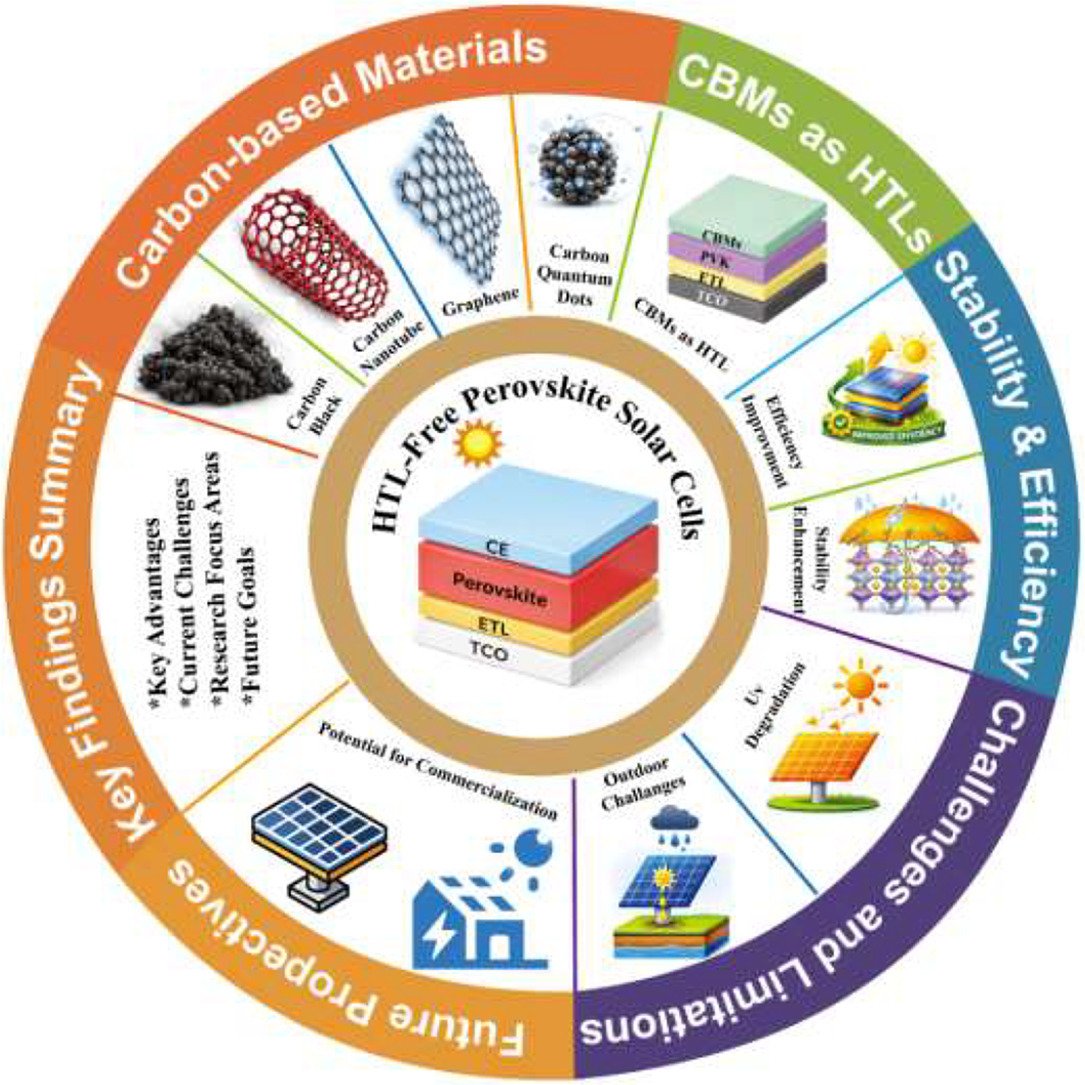
Perovskite solar cells offer high power conversion efficiency and strong potential for low-cost manufacturing. However, conventional devices rely on organic hole-transport layers and noble-metal electrodes, which are associated with high cost, limited stability, and complex fabrication processes. In response to these challenges, hole-transport-layer-free (HTL-free) perovskite solar cells have emerged as an important research direction. This review systematically summarizes recent advances in carbon-based materials, including carbon nanotubes (CNTs), graphene, carbon black (CB), and carbon quantum dots (CQDs), for HTL-free perovskite solar cells, with particular emphasis on their roles in charge extraction and transport, interfacial defect passivation, energy-level regulation, device stability, and scalable manufacturing.
The review further highlights that carbon-based materials combine good electrical conductivity, chemical stability, mechanical flexibility, and relatively low cost, making them promising for printable, flexible, semitransparent, and large-area perovskite photovoltaic devices. Nevertheless, commercialization still faces challenges, including interfacial contact resistance, insufficient hole selectivity, long-term stability, and consistency in large-area manufacturing. Future research should focus on carbon work-function regulation, interface passivation, low-temperature printing, and scalable manufacturing technologies to accelerate the transition of HTL-free perovskite solar cells from laboratory research toward practical applications.
This work was supported by the Guangdong Science and Technology Department (2024A1515010482) and the 2026 Joint Research Project between Shenzhen University and National Taipei University of Technology.
Original article: https://doi.org/10.1016/j.cclet.2026.113323