In 2026, Shenzhen University published a research paper titled "Controlled sweat generation via ultrasound stimulation integrated in a wearable device" in *Nature Communications*. This research developed a flexible wearable system integrating low-frequency ultrasound stimulation and electrochemical sensing, enabling active sweat induction in a resting state and real-time detection of multiple biomarkers in sweat, providing a new strategy for next-generation non-invasive health monitoring technology. Professor Xu Tailin and Dr. He Xuecheng are the corresponding authors, and master's student Chen Litong is the first author. Shenzhen University and the University of California, San Diego are the affiliated institutions.
Sweat is an important non-invasive biofluid containing abundant metabolites, ions, and physiological state-related information, which can be used for health monitoring and disease assessment. In recent years, wearable sweat sensing technology has received widespread attention, but how to stably and comfortably collect sweat in a resting state remains a key issue limiting its application. To address this challenge, the research team developed a flexible wearable platform based on ultrasound-assisted sweat generation. This system integrates a piezoelectric ultrasound module, a microfluidic sweat collection structure, and an electrochemical sensing array. Low-frequency ultrasound promotes transdermal drug delivery and activates local sweat gland secretion, achieving active sweating without movement or electrical stimulation. Results show that ultrasound stimulation effectively improves skin permeability, thereby inducing sweat production through transdermal drug delivery. Compared to iontophoresis methods under test conditions, ultrasound-induced sweating exhibits lower skin irritation and better wearing comfort. Combined with a multifunctional electrochemical sensing module, the platform can simultaneously detect indicators such as potassium ions (K+), pH, and uric acid (UA) in sweat. Human trials further showed a good correlation between sweat uric acid levels and blood uric acid concentration, validating the system's potential application in non-invasive metabolic monitoring. This study is the first to apply ultrasound transdermal drug delivery technology to non-invasive sweating, achieving integrated active sweat acquisition and multi-indicator detection, providing a new technological pathway for the development of continuous health monitoring and personalized medical devices.
This research was supported by the Shenzhen Science and Technology Plan, the National Natural Science Foundation of China, the Synthetic Biology Research Center of Shenzhen University, and related research projects.
Paper Link:
https://doi.org/10.1038/s41467-026-73789-4
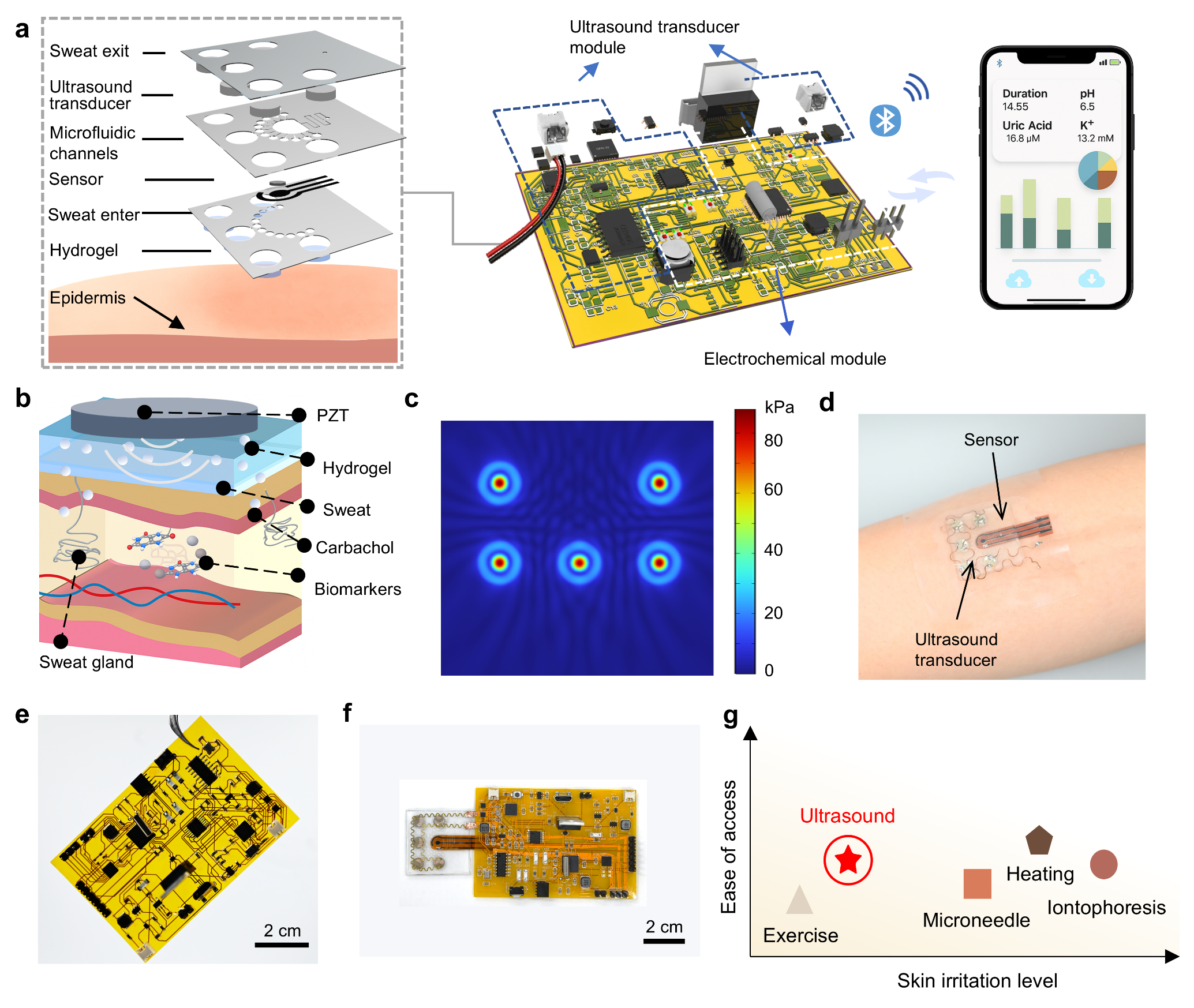
Figure 1. Schematic diagram of an ultrasound-driven wearable sweat generation and electrochemical detection platform.



