On August 6, 2026, Professor Xiuting Li’s research group at the Institute for Advanced Study developed an in situ and real-time electrochemical strategy based on nano-impact electrochemistry to probe the intrinsic phase transition kinetics of CsPbI3 perovskite quantum dots (QDs) during purification at the single-nanoparticle level. The work, entitled “In situ probing of phase transition kinetics of single CsPbI3 perovskite quantum dots via nano-impact electrochemistry”, was published in Chemical Science. Graduate students Xiaolin Zhang and Yu Tian are co-first authors, and Professor Xiuting Li is the corresponding author.
All-inorganic CsPbI3 perovskite QDs possess excellent optoelectronic properties. However, during purification with polar solvents such as ethyl acetate (EtOAc), its optoelectronically active perovskite γ phase can readily transform into the optically inactive non-perovskite δ phase, which significantly compromises the structural stability and optoelectronic performance of the QDs. Understanding the intrinsic kinetics of this phase transition at the single-particle level remains a big challenge. In this work, the researchers established an in situ electrochemical strategy based on nano-impact electrochemistry to probe the γ-to-δ phase transition kinetics of individual CsPbI3 QDs in EtOAc. By exploiting the distinct Pb reduction overpotentials of γ- and δ-phase CsPbI3, the γ-phase fraction of single QDs during solvent exposure was quantified in real time through statistical analysis of current spikes generated as individual QDs collided with a microelectrode. To further investigate the underlying kinetic mechanism, the Johnson–Mehl–Avrami–Kolmogorov (JMAK) model was applied to fit the kinetic curves obtained from nano-impact electrochemistry and and ex situ X-ray diffraction (XRD). The nano-impact electrochemical data yielded an Avrami exponent of 1.14 ± 0.04, suggesting that the γ-to-δ phase transition proceeds predominantly via heterogeneous nucleation followed by low-dimensional interfacial propagation under strong nanoscale confinement. Compared with ensemble-averaged ex situ XRD measurements, the nano-impact approach enables more accurate and precise kinetic analysis with enhanced mechanistic resolution. This work demonstrates that nano-impact electrochemistry enables in situ monitoring of phase transition kinetics at the single-particle level, revealing solvent-induced structural evolution and providing valuable guidance for the rational design of more stable QDs for optoelectronic and photovoltaic applications.
This work was supported by the 2026 National Taipei University of Technology-Shenzhen University Joint Research Program.
Article link: https://doi.org/10.1039/d6sc04719j
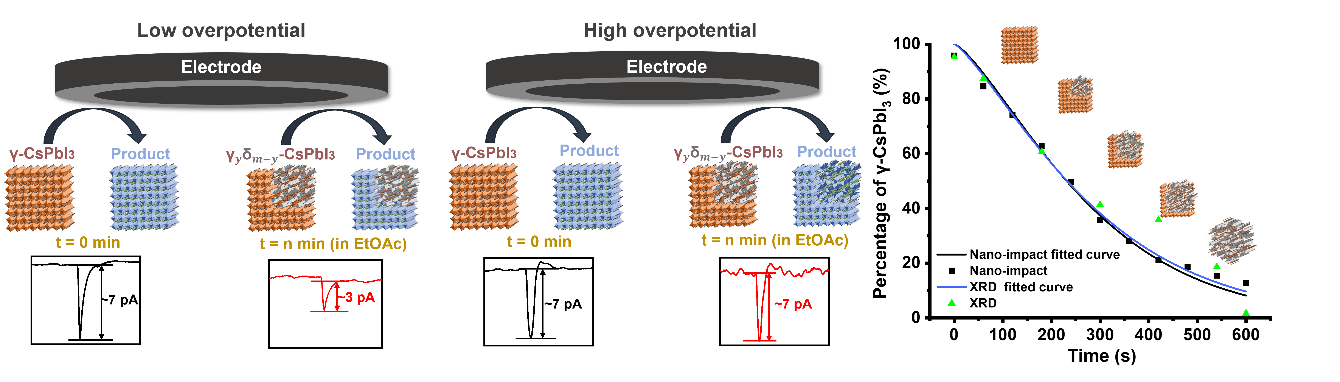
Fig. 1 Nano-impact electrochemistry enables in situ minitoring of the γ-to-δ phase transition kinetics of CsPbI3 QDs in EtOAc at the single-nanoparticle level.



