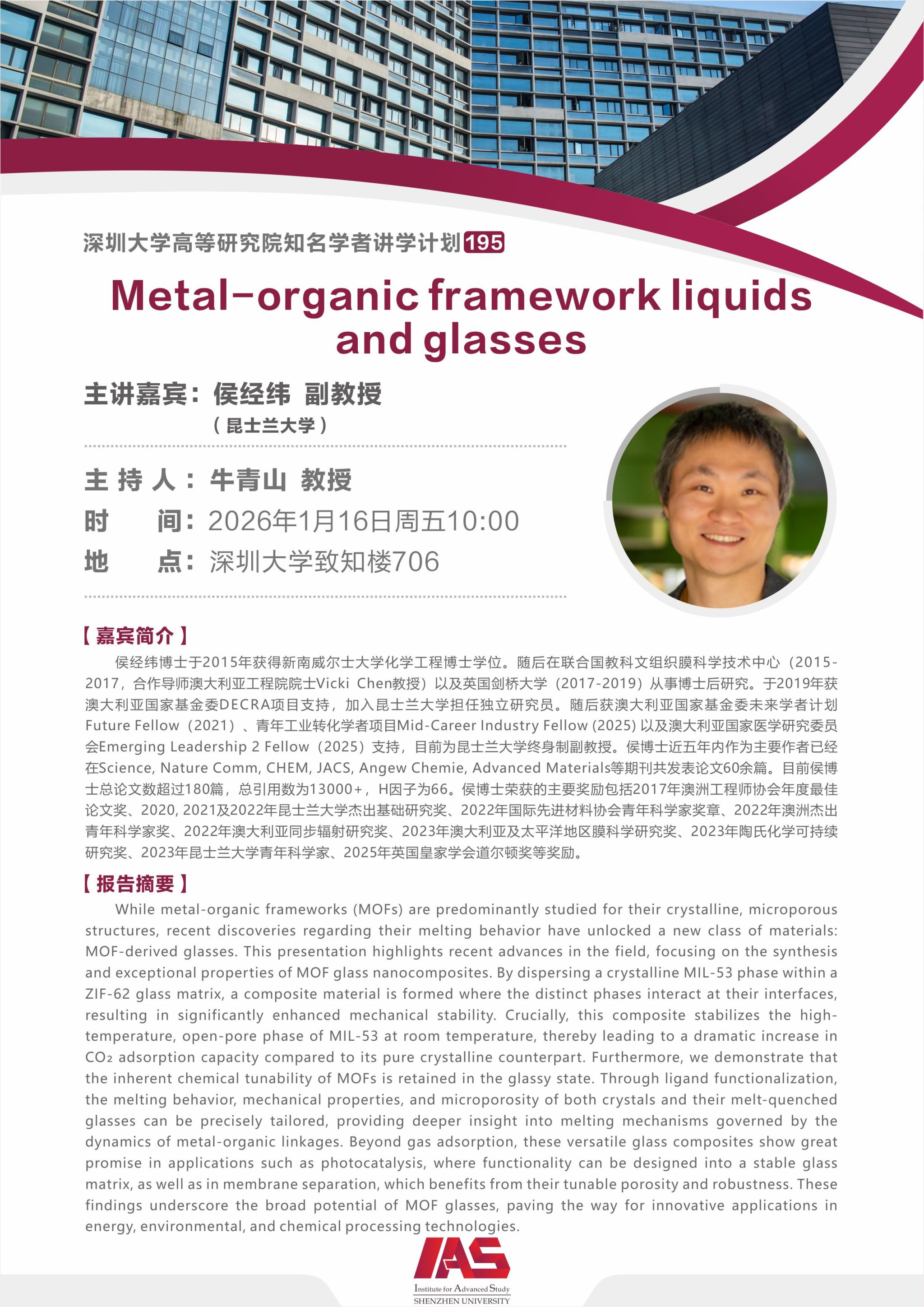
报告主题:Metal-organic framework liquids and glasses
主 讲 人:侯经纬 副教授(昆士兰大学)
主 持 人:牛青山 教授
时 间:2026年1月16日(五)10:00
地 点:致知楼706
嘉宾简介:
侯经纬博士于2015年获得新南威尔士大学化学工程博士学位。随后在联合国教科文组织膜科学技术中心(2015-2017,合作导师澳大利亚工程院院士Vicki Chen教授)以及英国剑桥大学(2017-2019)从事博士后研究。于2019年获澳大利亚国家基金委DECRA项目支持,加入昆士兰大学担任独立研究员。随后获澳大利亚国家基金委未来学者计划Future Fellow(2021)、青年工业转化学者项目Mid-Career Industry Fellow (2025) 以及澳大利亚国家医学研究委员会Emerging Leadership 2 Fellow(2025)支持,目前为昆士兰大学终身制副教授。侯博士近五年内作为主要作者已经在Science, Nature Comm, CHEM, JACS, Angew Chemie, Advanced Materials等期刊共发表论文60余篇。目前侯博士总论文数超过180篇,总引用数为13000+,H因子为66。侯博士荣获的主要奖励包括2017年澳洲工程师协会年度最佳论文奖、2020, 2021及2022年昆士兰大学杰出基础研究奖、2022年国际先进材料协会青年科学家奖章、2022年澳洲杰出青年科学家奖、2022年澳大利亚同步辐射研究奖、2023年澳大利亚及太平洋地区膜科学研究奖、2023年陶氏化学可持续研究奖、2023年昆士兰大学青年科学家、2025年英国皇家学会道尔顿奖等奖励。
报告摘要:
While metal-organic frameworks (MOFs) are predominantly studied for their crystalline, microporous structures, recent discoveries regarding their melting behavior have unlocked a new class of materials: MOF-derived glasses. This presentation highlights recent advances in the field, focusing on the synthesis and exceptional properties of MOF glass nanocomposites. By dispersing a crystalline MIL-53 phase within a ZIF-62 glass matrix, a composite material is formed where the distinct phases interact at their interfaces, resulting in significantly enhanced mechanical stability. Crucially, this composite stabilizes the high-temperature, open-pore phase of MIL-53 at room temperature, thereby leading to a dramatic increase in CO₂ adsorption capacity compared to its pure crystalline counterpart. Furthermore, we demonstrate that the inherent chemical tunability of MOFs is retained in the glassy state. Through ligand functionalization, the melting behavior, mechanical properties, and microporosity of both crystals and their melt-quenched glasses can be precisely tailored, providing deeper insight into melting mechanisms governed by the dynamics of metal-organic linkages. Beyond gas adsorption, these versatile glass composites show great promise in applications such as photocatalysis, where functionality can be designed into a stable glass matrix, as well as in membrane separation, which benefits from their tunable porosity and robustness. These findings underscore the broad potential of MOF glasses, paving the way for innovative applications in energy, environmental, and chemical processing technologies.