Xiuting Li research team at the Institute for Advanced Study has achieved a significant enhancement in pseudocapacitive performance by developing hydroxyl-rich Ti₃C₂Tₓ quantum dots and incorporating them into two-dimensional nanosheets. Entitled "Enhancing the pseudocapacitance of Ti₃C₂Tₓ with its own hydroxyl-rich quantum dots for increased redox sites and fast ion transport", the relevant research paper was published in Nanoscale on November 17, 2025, and included in the 2025 Nanoscale HOT Article Collection. Dr. Xiuting Li is the corresponding author, graduate student Yuanhang Zhu is the first author, and the Institute for Advanced Study, Shenzhen University, is the sole corresponding institution.
Although Ti3C2Tx MXene shows great promise as a pseudocapacitive material, its limited edge sites and slow interlayer ion transport restrict its electrochemical performance. In this paper, hydroxyl-rich Ti3C2Tx quantum dots (QDs) were synthesized by intercalation with tetramethylammonium hydroxide (TMAOH) and hydrothermal cutting. It was found that compared with nanoflakes, hydroxyl-rich QDs exhibited higher specific pseudocapacitance and rapid redox kinetics, which can be attributed to their abundant surface redox-active sites and efficient ion transport facilitated by hydrogen-bond networks. The incorporation of 20 wt% hydroxyl-rich QDs into nanoflakes exhibits not only a high specific capacitance of 372.2 F g−1 at 10 mV s−1 (20% higher than that of Ti3C2Tx nanoflakes alone), but also significantly enhanced cycling stability (100% capacitance retention after 10 000 cycles at a current density of 10 A g−1). The incorporation of hydroxyl-rich QDs improved the stacking of nanoflake materials and alleviated mechanical stress during charge–discharge processes, thereby ensuring robust cycling stability. This study highlights the superior pseudo-capacitance of hydroxyl-rich Ti3C2Tx QDs and the significance of rational design of MXene-based hybrid materials for energy storage applications.
This work was supported by the National Natural Science Foundation of China (No. 22004085). The authors also thank the Instrumental Analysis Center of Shenzhen University for the TEM characterization.
Paper link: https://pubs.rsc.org/en/content/articlelanding/2025/nr/d5nr04116c
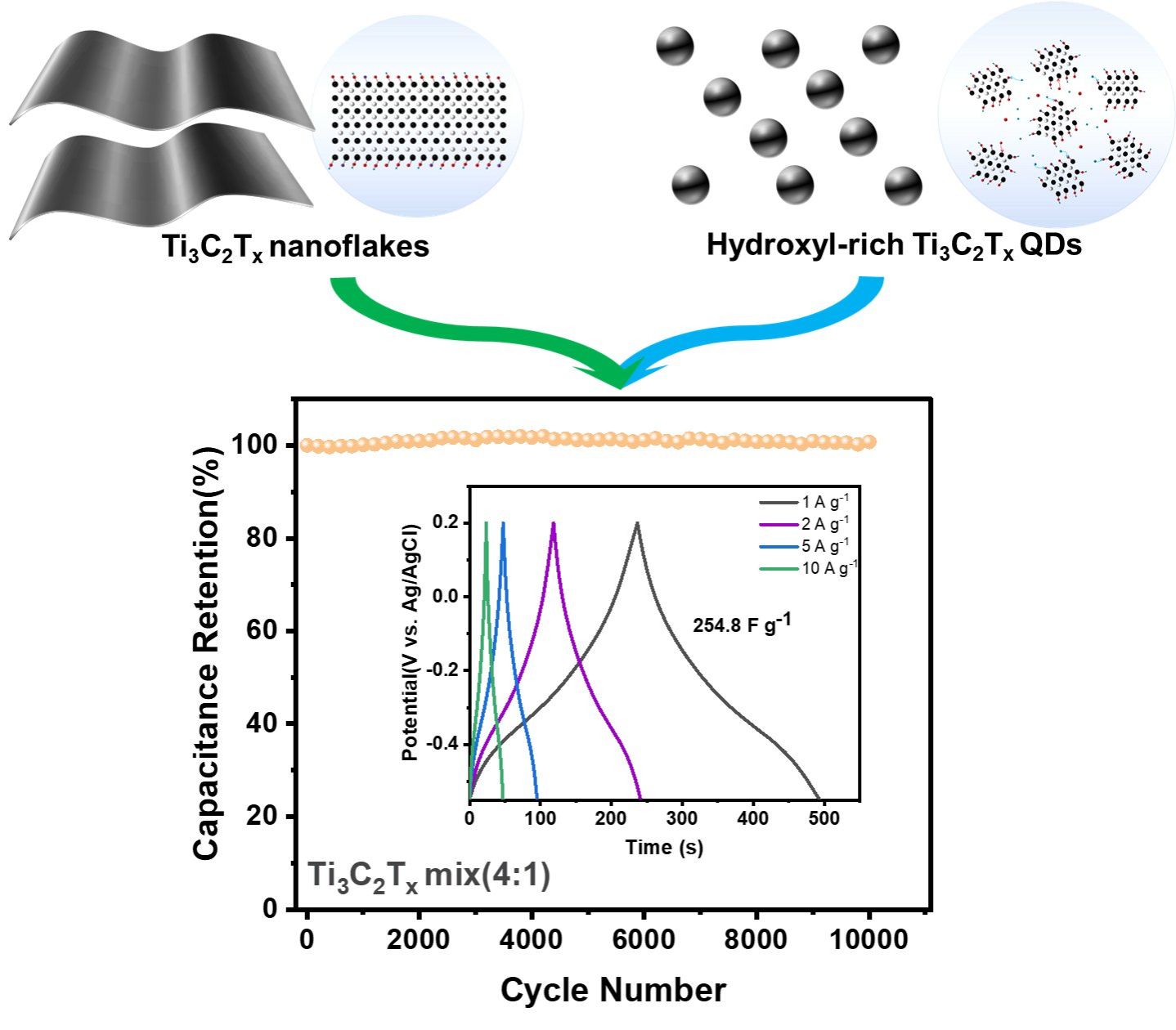
Figure 1. Hydroxyl-rich quantum dots enhance Ti3C2Tx pseudocapacitance by providing abundant redox-active sites and enabling rapid ion transport.



