Muhammad Ali Tajwar a, b, Muhammad Muzammal Hussain b, Farid Ahmed b, Abdul Hafeez a, b, Yen Wei c, and Hai Xiong a, b *
On December 25th, Prof. Xiong group from the Institute for Advanced Studies at Shenzhen University published a review paper titled “The Developing Trend about Heteroatom/Metal-Doped CDs as Nanozyme Mimics for the Detection and Imaging of Active Biomolecules” on Coordination Chemistry Review (https://doi.org/10.1016/j.ccr.2025.217530). Prof. Hai Xiong is the only corresponding author, and Mr. Muhammad Ali Tajwar is the first author. Shenzhen University is the first corresponding affiliation.
The detection and imaging of bioactive molecules, such as nucleic acids, polysaccharides, lipids, enzymes, and metabolites, are pivotal to advancing clinical diagnostics, drug discovery, fundamental biological research, and environmental monitoring. Recent developments on heteroatom/metal-doped carbon dots as nanozyme mimics (H/M-CDs-NMs) show great promise as new candidates, owing to their unique combination of advantageous properties. These include intrinsic biocompatibility, chemical stability, cost-effective synthesis protocols, superior catalytic activity, tunable photoluminescence characteristics, and customizable surface functionalities tailored for targeted bimolecular sensing and imaging applications. The purpose of this review is to describe the state-of-the-art developments and engineering and biomedical applications of H/M-CDs-NMs for the detection and imaging of bioactive molecules. The review presents a systematic approach on how the catalytic and optical properties of doped-CDs are influenced by specific physicochemical parameters such as particle size, the species of heteroatom/metal doping, and surface functional groups. This review provides a detailed discussion on the critical aspects: (i) synthetic approaches, (ii) classification frameworks for doping elements, and (iii) underlying catalytic mechanisms. This work highlights the understanding of catalytic actions and the corresponding coordination geometries prescribed by the coordination complex surfaces of the carbon dots. By integrating these fundamental understandings, this work ultimately seeks to establish design principles for engineering next-generation H/M-CDs-NMs with enhanced sensitivity, superior molecular discrimination capability, and broad-spectrum utility in diagnostic platforms, biomedical technologies, and environmental monitoring systems.
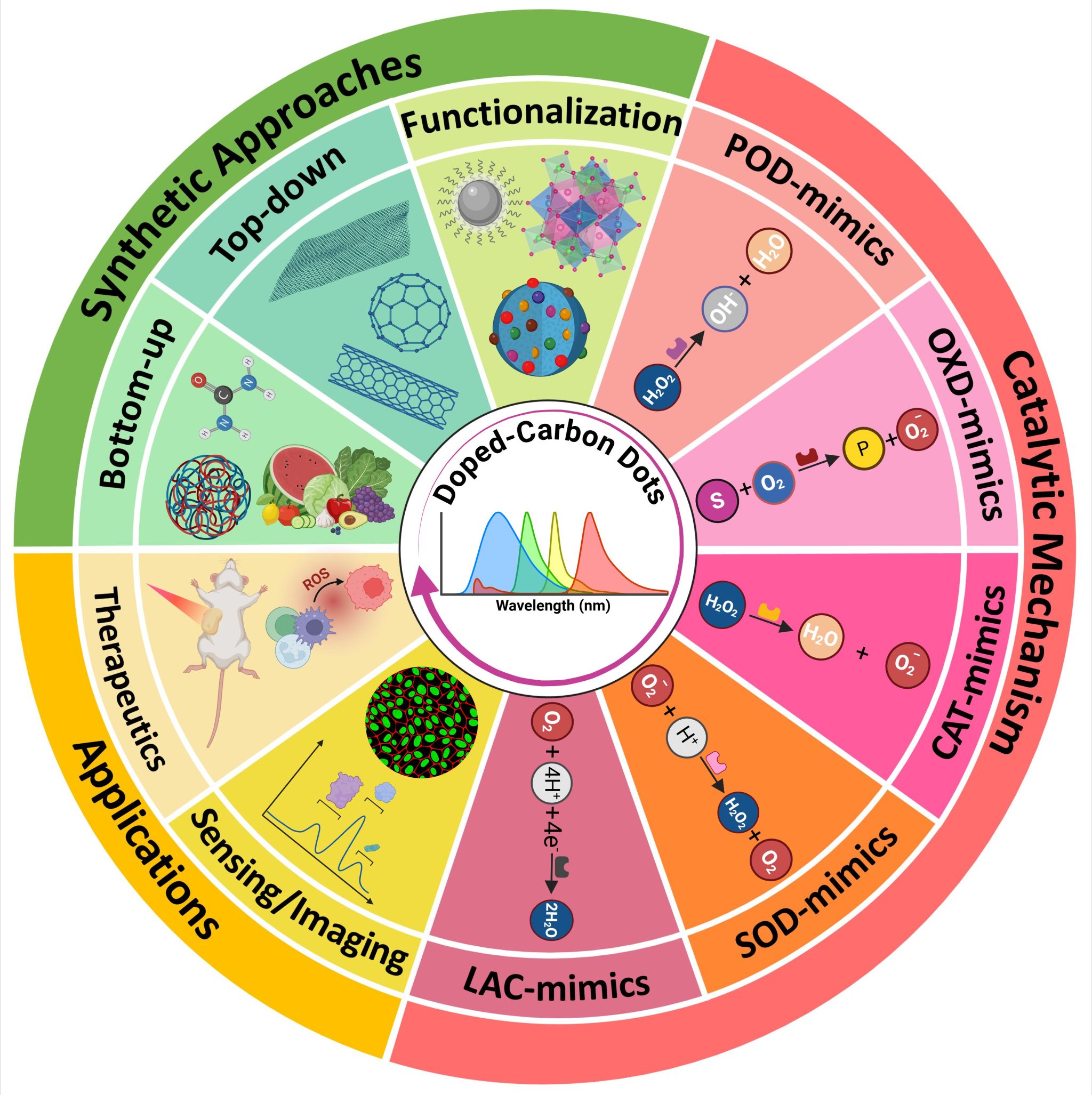
Figure 1. The diagram of heteroatom/metal-Doped CDs as Nanozyme Mimics about synthetic approached, catalytic mechanism, and applications on the detection and imaging of active biomolecules.



