On December 23, 2025, Chunyu Ding’s team at the Institute for Advanced Study, Shenzhen University, in collaboration with Prof. Hongzhi Cui from the College of Civil and Transportation Engineering, published a research article entitled “A Natural Shelter Within the Moon’s First 5 m on the Nearside Enables Habitable Base Siting” in the international leading journal IEEE Transactions on Geoscience and Remote Sensing. The study focuses on a shallow subsurface cavity detected by ground-penetrating radar at the Chang’E-3 landing site, and quantitatively evaluates its thermal stability and engineering feasibility as a natural shelter on the Moon, providing critical evidence to inform future strategies for crewed lunar base site selection. The Institute for Advanced Study, Shenzhen University is the first affiliation. Prof. Hongzhi Cui and Prof. Chunyu Ding serve as corresponding authors, and Dr. Yuxiao Zhi (postdoctoral researcher) is the first author. Co-authors include Academician Qingquan Li (Shenzhen University), Academician Yaolin Shi (University of Chinese Academy of Sciences), Dr. Yan Su (National Astronomical Observatories, CAS), Prof. Zhiyong Xiao (Sun Yat-sen University), Prof. Teng Fei (Harbin Institute of Technology), and Dr. Ravi Sharma (postdoctoral researcher, Shenzhen University).
The lunar surface exists in an environment of high vacuum and intense irradiation, undergoes extreme diurnal temperature excursions, and is persistently exposed to cosmic radiation and micrometeoroid bombardment. Compared with the exposed surface, shallow subsurface voids may naturally buffer severe thermal fluctuations and provide shielding from multiple hazards, making them promising candidates for long-term human presence and stable operation of critical equipment on the Moon. In this study, the team used a shallow void identified by the Yutu rover’s ground-penetrating radar at the Chang’E-3 landing site as a prototype. By integrating Diviner surface temperature measurements, LOLA albedo data, and radar-inverted density profiles, the researchers built a thermal numerical model to simulate the coupled conduction–radiation heat transfer within both a sealed void and a “skylight” excavation scenario over a lunar-day cycle, and systematically compared thermal stability under different opening diameters. The results show that the interior thermal environment is generally stable, and that smaller openings lead to weaker temperature variations. Even with a 2 m-diameter skylight, the interior day–night temperature change can still be constrained to within 20 K. The team suggests that this stability is closely related to the site’s mid-latitude location, limited solar incidence, and the strong insulating properties of lunar regolith, further supporting the thermal feasibility of “accessible shallow voids” as natural shelter spaces for future lunar bases.
To ensure model reliability, the team validated the simulated surface temperatures against Diviner observations and found strong agreement, with an RMSE of 4.4035 K and a MAPE of 1.7578%. These results indicate that the adopted thermal parameters and boundary conditions are robust, supporting further scenario analysis and engineering design. Overall, the study establishes a quantitative and comparable thermal evaluation framework for future lunar base site selection: on the one hand, it can help screen shallow subsurface candidates with superior thermal stability; on the other hand, it demonstrates how opening size governs interior thermal fluctuations, providing key guidance for optimizing design and construction schemes by balancing accessibility, thermal stability, and engineering practicality, and offering actionable reference for site assessment and concept validation for lunar base development.
This work was supported by the National Natural Science Foundation of China, the Guangdong Outstanding Youth Fund, the Shenzhen Science and Technology Innovation Commission, and the Shenzhen University “2035 Pursuing Excellence” Research Program, among others.
Paper link: https://ieeexplore.ieee.org/document/11299104
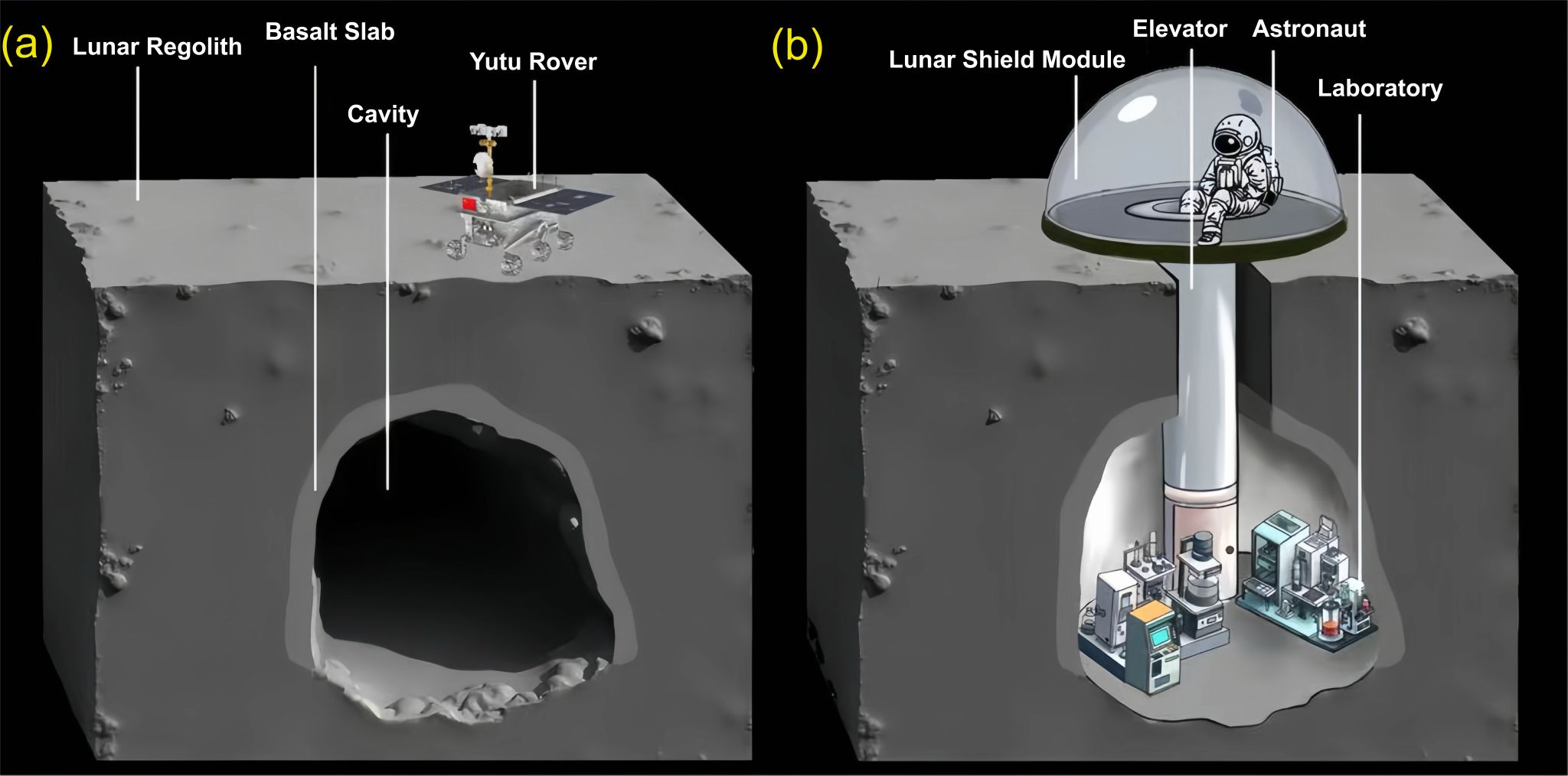
Figure 1. Schematic of future base construction in the underground cavity for Chang’E-3, showing: (a) subsurface cavity and (b) scheme for future base construction after excavating the underground cavity



