Farid Ahmed, Saima Hameed, Muhammad Muzammal Hussain, Jiarong Nan, and Hai Xiong*
On March 21th, Prof. Xiong group from the Institute for Advanced Studies at Shenzhen University published a research paper titled “Red-emissive carbon dot (RCDs@Ag+) nanohybrid as a dual-functional platform for glutathione sensing and antibacterial applications” on Analytica Chimica Acta (https://doi.org/10.1016/j.aca.2026.345426). Prof. Hai Xiong is the only corresponding author, and Dr. Farid Ahmed is the first author. Shenzhen University is the only corresponding affiliation.
Biothiols, especially glutathione (GSH), are crucial for cellular redox balance, detoxification, and disease progression, and require highly sensitive and selective detection methods in biological, clinical, and food-safety contexts. Red-emitting carbon dots are ideal due to their photostability, biocompatibility, and adjustable optical features. Meanwhile, silver-based nanocomposites demonstrate potent antimicrobial properties and improve analytical signals by facilitating efficient electron transfer and fluorescence control. Combining these components into a single nanoplatform offers a promising approach to creating multifunctional probes for biosensing and antimicrobial applications. Herein, Red-emissive carbon dots (RCDs) were synthesized via a solvothermal process from 1,2,4-triaminobenzene and dopamine. Upon treatment with AgNO3, the fluorescence of RCDs was significantly quenched, yielding RCDs@Ag⁺ nanocomposites characterized by TEM, SEM, XRD, and XPS analysis. The RCDs@Ag+ nanocomposites served as a nanoprobe for GSH detection, exhibiting very high sensitivity across a wide range of GSH concentrations (0.1-20 µM), with a detection limit of 12 nM. The probe selectively identified GSH, effectively distinguishing it from other biothiols such as cysteine and homocysteine. It also maintained stability under extreme pH and high electrolyte concentrations, including complex food samples. Both RCDs and RCDs@Ag+ demonstrated significant antimicrobial activity against Gram-negative bacteria, highlighting their dual function as bactericidal agents alongside their GSH-sensing ability. Furthermore, the synthesized RCDs@Ag+ nanocomposite was successfully used to detect GSH in real food samples, with satisfactory recoveries (96.16% to 106.2%).
This study introduces a red-emissive carbon dot silver nanohybrid (RCDs@Ag⁺) that serves as a dual-purpose platform for highly sensitive glutathione (GSH) detection and antibacterial activity. The nanoprobe shows a remarkably low detection limit, high selectivity over competing biothiols (Cys and Hcy), and excellent stability across various physiological and food-related conditions. Additionally, RCDs@Ag+ nanohybrids demonstrate potent antimicrobial efficacy. The integration of fluorescence sensing and antimicrobial functions into a single nanoplatform highlights its potential applications in food quality monitoring and advanced bioanalytical systems (Fig.1).
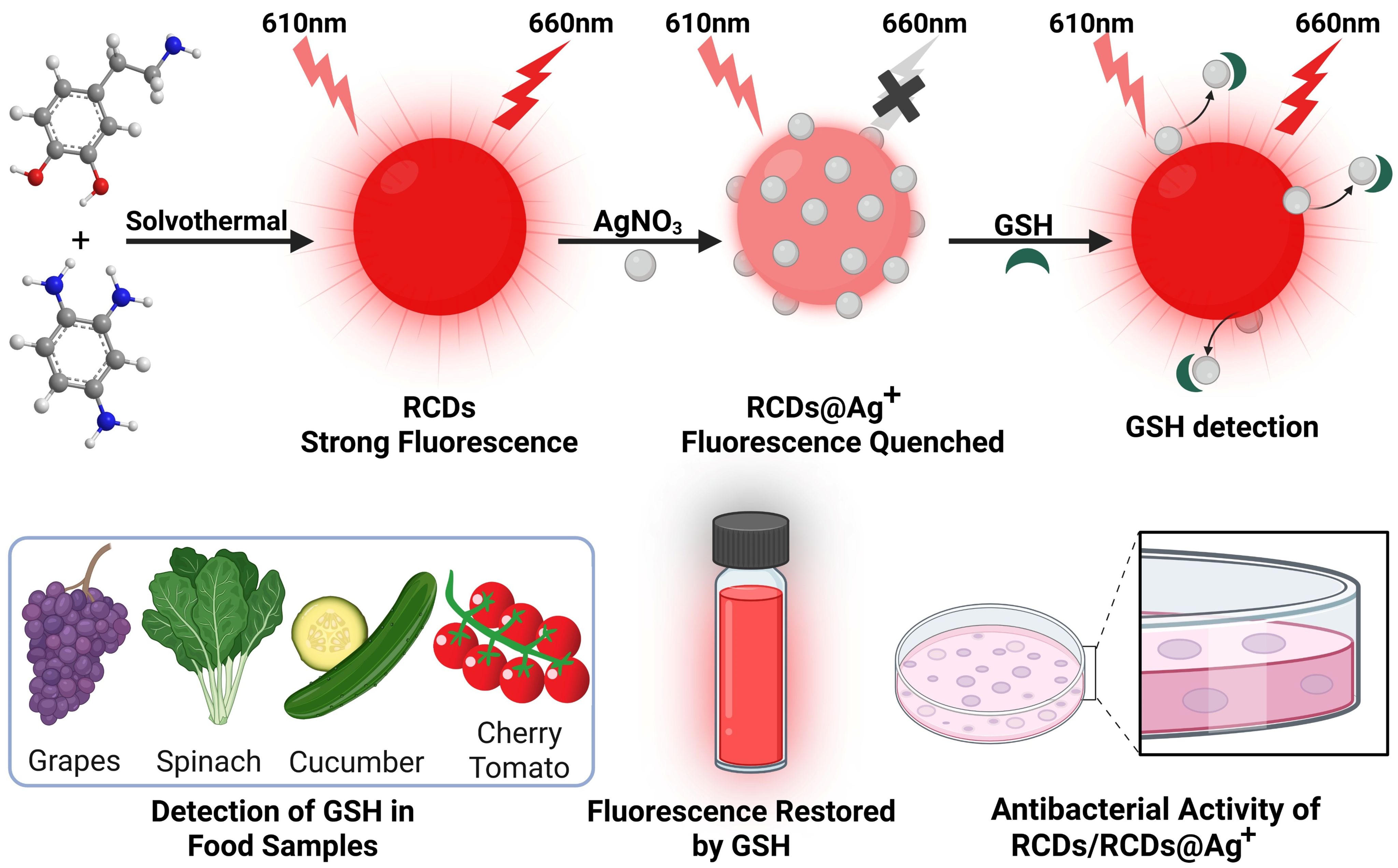
Fig. 1. The diagram of red-emissive CDs as a dual-functional platform for glutathione sensing and antibacterial applications.



