On July 7, 2026, Associate Professor Wenjin Li's research group published a review article entitled "AI-driven biomolecular design: Modalities, models, and translation" in Biomaterials. The review systematically summarizes the latest advances in AI-driven biomolecular design from 2020 to 2026. Dr. Mehmoona Azmat is the first author of the paper, while Associate Professor Wenjin Li serves as the corresponding author. The Institute for Advanced Study, Shenzhen University, is the sole corresponding affiliation.
Artificial intelligence (AI) is rapidly transforming life sciences by enabling the rational and efficient design of biomolecules. This review focuses on three major classes of biomolecules—peptides, antibodies, and aptamers—and provides a comprehensive overview of cutting-edge AI technologies, including machine learning, protein language models, graph neural networks (GNNs), Transformer-based architectures, and diffusion models. The authors discuss how these approaches have revolutionized biomolecular design and highlight their tremendous potential in drug discovery, biomaterials development, and precision medicine.
Beyond summarizing recent technological advances, the review emphasizes that the true value of AI lies not only in designing high-performing biomolecular candidates but also in addressing practical challenges such as synthesizability, structural stability, biocompatibility, and large-scale manufacturability. To bridge the gap between computational design and real-world applications, the authors advocate a Design–Build–Test–Learn closed-loop framework that tightly integrates artificial intelligence, automated experimentation, and biological validation. Such an iterative strategy enables continuous model refinement through experimental feedback, facilitating the transition of AI from a predictive tool to a powerful engine for innovation. The proposed framework is expected to accelerate the development and clinical translation of next-generation biomaterials and biopharmaceuticals while providing new perspectives for AI-enabled life science research.
This work was supported by the Shenzhen Science and Technology Program (Grant No. JCYJ20240813142512017)
Article link: https://www.sciencedirect.com/science/article/abs/pii/S0142961226004552
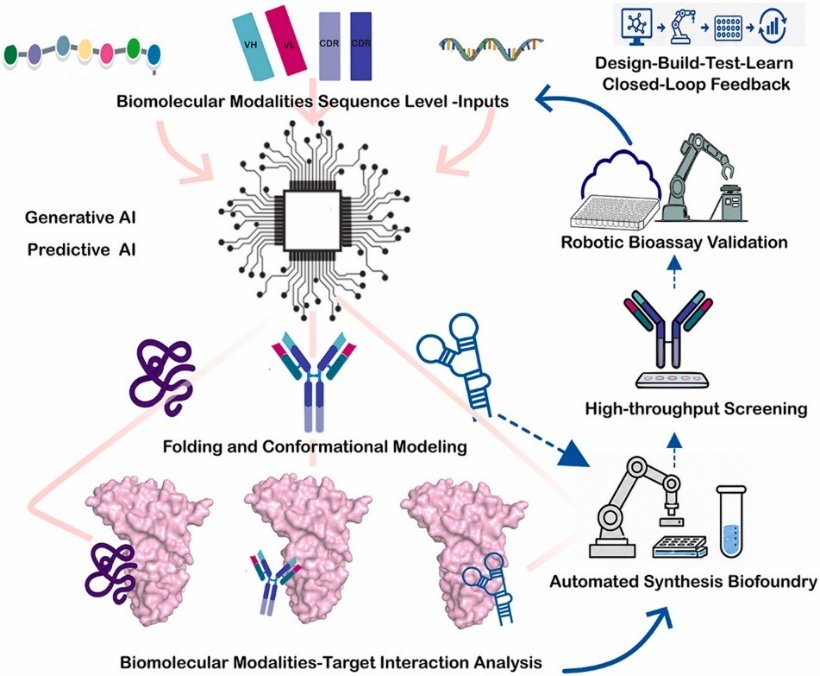
Figure 1. AI-driven biomolecular design: Modalities, models, and translation



