Mohsin Ali a, ¶, Muhammad Ali Tajwar a, b, ¶, Farid Ahmed a, Muhammad Muzammal Hussain a, Wai-Yeung Wong c, Hai Xiong a, b, *
a Institute for Advanced Study, Shenzhen University, Shenzhen 518060, PR China.
b College of Chemistry and Environmental Engineering, Shenzhen University, Shenzhen 518060, PR China.
c Department of Applied Biology and Chemical Technology, The Hong Kong Polytechnic University, Hung Hom, Hong Kong, P. R. China
¶ These authors contributed equally to this work.
On July 9th, Prof. Xiong's group from the Institute for Advanced Studies at Shenzhen University published a review paper titled “Emerging Trends in Artificial Intelligence-Driven Drug Discovery: Balancing Chemical Design and Pharmacological Properties for Cancer Therapy” on Medicinal Research Reviews (https://doi.org/10.1002/med.70086). Prof. Hai Xiong is the only corresponding author; Mohsin Ali and Muhammad Ali Tajwar (Ph.D students) are the first co-authors. Shenzhen University is the first corresponding affiliation.
Traditional cancer drug discovery encounters challenges, including lengthy synthesis durations, high costs, and a 90% failure rate in clinical trials, primarily due to inadequate chemical design and drug properties. Artificial intelligence (AI) provides powerful computational tools to overcome these issues by speeding up target identification, predicting properties, and optimizing leads. This review emphasizes the influence of new AI platforms like AlphaFold3, molecular interactions are structurally optimized (MISATO), and ZairaChem on the discovery of oncology drugs. We specifically examine how AI reconciles chemical design with pharmacological feasibility. In addition to evaluating these advancements, we meticulously evaluate methodological challenges, including dataset bias, overfitting, insufficient external validation, and reproducibility issues. Furthermore, the development of complex and targeted modalities, such as antibody-drug conjugates (ADCs), aptamer-drug conjugates (Ap‑DCs), and proteolysis-targeting chimeras (PROTACs), is being explored for cancer treatment using AI. Following a detailed review of regulatory and clinical translation issues, this review presents practical tips for improving model validation, data sharing, and incorporation into medicinal chemistry workflows. By examining successes and persistent limitations, this review article offers a strategic roadmap for leveraging AI to provide clinically translatable cancer therapies with enhanced chemical and pharmacological balance (Fig.1).
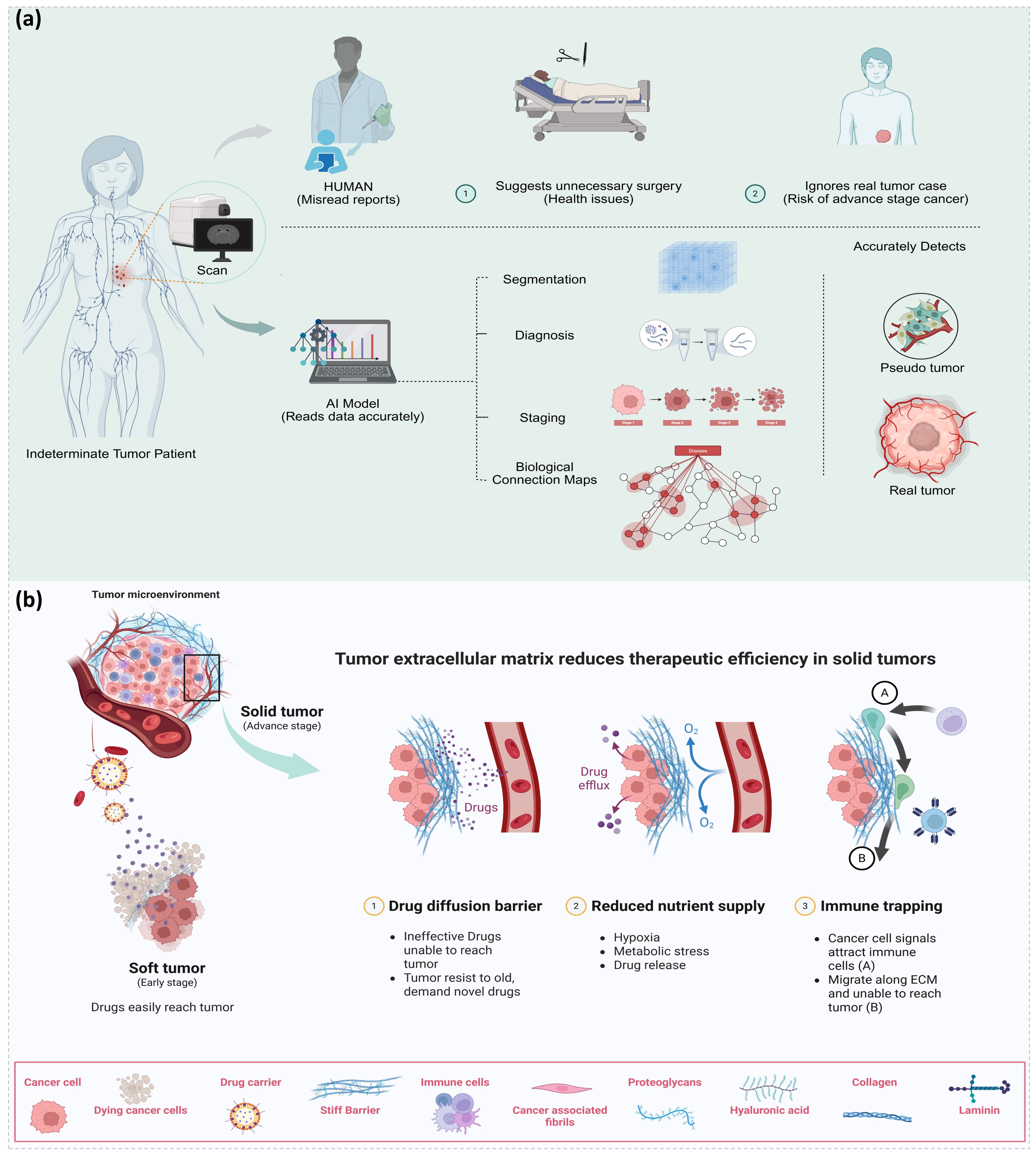
Fig. 1 (a) A visual comparison highlighting human misunderstanding versus the precise differentiation made by AI between pseudo and real tumors; (b) An overview of the therapeutic difficulties encountered in managing soft tumors at their initial phase, compared to advanced-stage solid tumors that create dense resistance barriers.



