On July 8th, 2026, the research team led by Researcher Lei Qin from the Institute for Advanced Study of Shenzhen University, in collaboration with Dr. Jieren Shao from the Ohio State University, has published a research paper entitled "Regulating KO2 Deposition via Crystal–Void Size Matching in K–O2 Batteries" in the journal Chemical Communications. For the first time, this work systematically reveals the structure–activity relationship between the pore architecture of carbon-based gas diffusion layers (GDLs) and the deposition behavior of potassium superoxide (KO2) discharge products, proposing a crystal–void size matching principle that provides a rational design framework for high-capacity K–O2 batteries (POBs). Shenzhen University is the primary affiliation, with Xinyang Zhang as the first author of the paper, and Researcher Lei Qin as the sole corresponding author.
POBs, benefiting from the natural abundance of potassium and the low overpotential of the single-electron KO2 redox pathway, are regarded as promising candidates for next-generation low-cost and high-energy-density energy storage systems. However, the uncontrolled accumulation of the discharge product KO2 within the GDL leads to inappropriate cathode passivation and mass transport blockage, severely limiting the practical capacity output of POBs. Despite the widespread adoption of high-surface-area carbon materials as ideal cathode GDL hosts, a systematic understanding of how carbon frameworks of different dimensionalities regulate KO2 deposition behavior remains lacking.
This study examined four representative carbon-based GDLs, including 1D carbon nanotubes (CNT), 2D graphene, 3D graphene microsponges (GMS), and commercial carbon paper, to systematically evaluate the influence of structural dimensionality on POB discharge performance. The results reveal that KO2 follows a solution-mediated growth mechanism in KPF6–DME electrolyte, forming microscale cubic crystals. When the microscale macropores of the GDL are size-matched with KO2 crystallites, the products can deposit within the bulk phase while maintaining open transport channels. Conversely, materials dominated by nano/mesopores, such as GMS, undergo rapid surface nucleation and coalescence of KO2 crystals into a dense passivating layer despite possessing a specific surface area as high as 1054.2 m2 g-1, rendering the abundant internal porosity inaccessible and yielding a capacity of approximately 2 mAh. In contrast, the CNT electrode, leveraging its microscale macroporous framework, delivered a discharge capacity of 8.8 mAh, more than four times that of GMS. SEM and mercury intrusion porosimetry analysis further confirmed the decisive role of pore size in the deposition process. This study overturns the conventional assumption that specific surface area alone dictates capacity and establishes for the first time that the core design criterion for POB cathode GDLs should center on microscale macropores in the 10–100 μm range, enabling structural commensuration between crystallite size and void space. These findings provide a clear direction for the engineering design of GDLs for next-generation high-capacity K–O2 batteries.
This research was supported by the Shenzhen Science and Technology Program (Grant No. JCYJ20240813142526034, No. JCYJ20250604182101002), the Guangdong Basic and Applied Basic Research Foundation (Grant No. 2025A1515010810), the National Natural Science Foundation of China (Grant No. 52301280), the Guangdong Provincial Project (2024QN11C266), and the Scientific Foundation for Youth Scholars of Shenzhen University (Grant No. 868-000001032171).
Link to the paper: https://pubs.rsc.org/cc/article/doi/10.1039/d6cc03170f/1278381
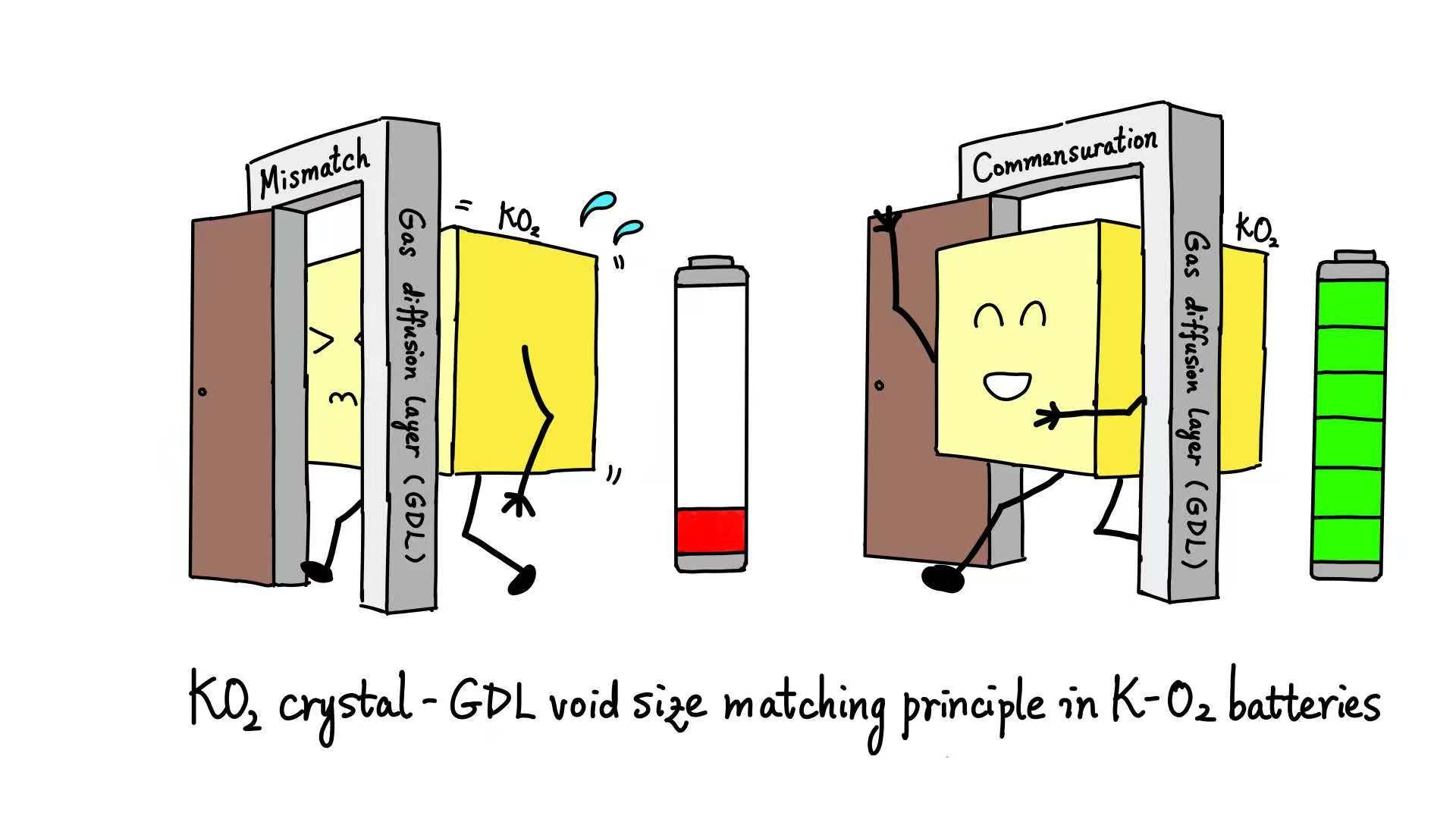
Figure 1. Schematic illustration of the crystal–void size matching principle in K–O2 batteries.



