On July 22nd, 2026, the research team led by Researcher Lei Qin at the Institute for Advanced Study (IAS), Shenzhen University, in collaboration with Dr. Xiaojuan Chen from Sichuan University, published a research paper entitled "Janus Highly Fluorinated Ether: K+-Channel Activator or Anode Corrosion Trigger in High-Concentration Electrolytes for K–O2 Batteries?" in the journal Advanced Functional Materials. For the first time, this work reveals the Janus effect of highly fluorinated ether (HFE) as a co‑solvent in high‑concentration electrolytes (HCE) for potassium–oxygen batteries (POBs): excessive HFE addition triggers severe K corrosion, whereas an optimal amount enables the formation of a solid electrolyte interphase (SEI) that synergistically functions as both an oxygen barrier and a K+‑conductive channel, achieving long‑term anode protection and fast interfacial kinetics. By precisely tuning the HFE ratio, this study innovatively resolves the long‑standing challenge of anode corrosion in K–O2 batteries while maintaining efficient interfacial ion transport, significantly lowering the barriers for practical application of K–O2 batteries. Shenzhen University is the primary affiliation, with Dr. Yu Zhong as the co‑first author (ranked first) and Researcher Lei Qin as the sole corresponding author.
POBs exhibit great potential for future energy storage applications, featuring high theoretical energy density based on potassium superoxide (KO2) and earth‑abundant resources. However, the failure of the K anode induced by oxygen crossover severely limits their cycle life and capacity. Although high‑concentration potassium salt electrolytes (HCEs) can achieve effective anode passivation, their high viscosity and cost restrict practical implementation, necessitating the introduction of a low‑polarity co‑solvent to improve the performance. This study reveals that in the potassium bis(trifluoromethanesulfonyl)imide (KTFSI)/dimethoxyethane (DME) electrolyte, the HFE co‑solvent exhibits a Janus effect in constructing the anode interfacial passivation layer. When the HFE content is excessive (HCE:HFE = 1:1), solvated electrons generated from the reaction between DME and K metal aggressively attack HFE molecules, triggering a cascade defluorination reaction that completely corrodes the K metal into black decomposition products with battery failure. In contrast, when the HFE content is optimized to HCE:HFE = 12:1, the HFE‑derived SEI exhibits high and uniformly distributed KF content, which effectively blocks oxygen crossover while providing efficient K+ transportation. In situ titration mass spectrometry (TMS) confirms that the generation of gaseous byproducts such as CH4 and C2H4 is suppressed to be close to the detection limit (1–2 ppm), demonstrating that interfacial reactions are well controlled. Based on the optimized electrolyte formulation, the assembled K–O2 battery achieves over 200 stable cycles (>800 h) at a current density of 0.05 mA/cm2, with an average coulombic efficiency of 98.1%.
This study not only clarifies the dual role of HFE in the construction of the anode SEI in high‑concentration electrolytes—acting as either a “protector” or a “corrosive agent”—but also proposes a new electrolyte design paradigm based on interfacial self‑limiting reactions. This work provides new insights for electrolyte engineering in K–O2 batteries and other alkali metal–oxygen batteries, and lays an important foundation for the practical development of high‑energy‑density, long‑life metal–air batteries.
This work was supported by the Guangdong Basic and Applied Basic Research Foundation (Grant No. 2025A1515010810), the Shenzhen Science and Technology Program (Grant No. JCYJ20240813142526034, No. JCYJ20250604182101002), the National Natural Science Foundation of China (Grant No. 52301280), the Guangdong Provincial Project (2024QN11C266), and the Scientific Foundation for Youth Scholars of Shenzhen University (Grant No. 868-000001032171).
Link to the paper: http://doi.org/10.1002/adfm.77210
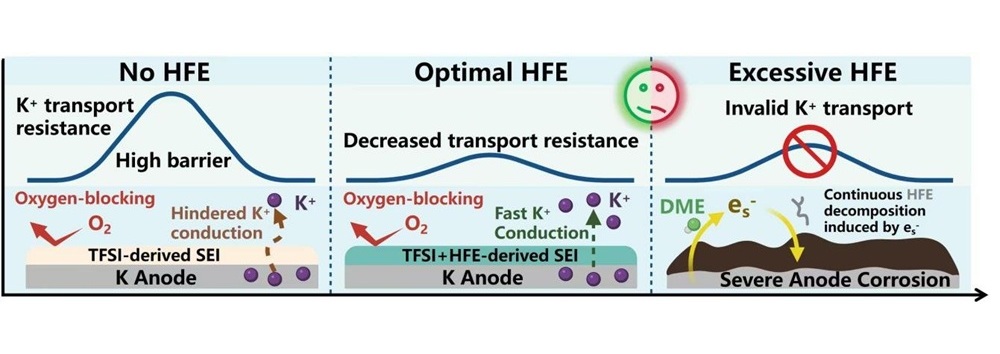
Figure 1. Schematic diagram of the influence mechanism of HFE concentration on the construction of the interfacial passivation layer at the metal anode in K–O2 batteries.



