On July 30th, 2026, the research group led by Researcher Lei Qin at the Institute for Advanced Study, Shenzhen University, in collaboration with Professor Yiying Wu from the Ohio State University, published a research article entitled “A KO2-Based Solid Superoxide Reservoir for Irreversible Capacity Compensation in Superoxide-Based Na–O2 Batteries” in the Journal of the American Chemical Society (JACS). For the first time, the authors report the use of commercially available potassium superoxide (KO2) as a sacrificial solid superoxide reservoir to compensate for the irreversible loss of rechargeable superoxide species in Na–O2 batteries based on sodium superoxide (NaO2) chemistry. By introducing a chemistry-driven compensation strategy, this work circumvents the complexity associated with conventional catalyst design and electrolyte engineering approaches, highlighting the unique potential of chemical compensation for sustaining active oxygen redox chemistry. Shenzhen University is the primary affiliation with Cuiyi Deng as the co-first author (ranked first). Researcher Lei Qin and Professor Yiying Wu serve as the corresponding authors.
Rechargeable Na–O2 batteries have emerged as one of the most promising next-generation electrochemical energy storage technologies owing to their exceptionally high theoretical specific energy and the natural abundance of both sodium and oxygen. Compared with peroxide-based reaction pathways, the superoxide chemistry featuring NaO2 as the dominant discharge product offers significantly lower decomposition overpotentials, faster reaction kinetics, and catalyst-free operation. Nevertheless, the practical implementation of superoxide-based Na–O2 batteries remains fundamentally limited by the thermodynamic instability of NaO2. During battery operation, NaO2 readily undergoes disproportionation to form Na2O2 or nucleophilic attack on electrolyte components, resulting in the continuous accumulation of irreversible by-products, persistent electrolyte degradation, and progressive depletion of both active sodium inventory and rechargeable superoxide species. These degradation processes manifest as limited Coulombic efficiency (CE), increased voltage polarization, and rapid capacity fading during cycling. Although extensive efforts have focused on electrolyte engineering, gas diffusion layer (GDL) microstructure optimization, and cathode catalyst integration, these preventive strategies generally require complicated fabrication procedures and increased cost, while fundamentally failing to compensate for the cumulative loss of active sodium inventory once irreversible side products have formed. To address this long-standing challenge, the authors directly employed commercially available KO2 as a solid superoxide reservoir. By pre-loading KO2 onto the GDL through a simple drop-casting process, we established a stoichiometrically controllable and decomposable superoxide equivalent capable of replenishing active superoxide species during battery charging. Mechanistic investigations combined with spectroscopic analyses revealed that the preloaded KO2 performs two complementary functions. It serves not only as an additional superoxide source to immediately compensate for the early-stage irreversible capacity loss, but also as a reaction promoter that facilitates the reversible formation of NaO2. Benefiting from this reservoir-mediated compensation mechanism, the Na–O2 battery delivers unprecedented reversibility and long-term cycling stability, achieving an average CE of 98.5% over 600 charge–discharge cycles. By completely bypassing the complexity associated with catalyst development and electrolyte engineering, this work provides compelling evidence that chemical compensation represents an effective strategy for sustaining active oxygen redox chemistry. More importantly, the concept of a solid superoxide reservoir establishes a scalable and broadly applicable design paradigm for mitigating oxygen-related irreversible capacity loss in rechargeable alkali metal–oxygen batteries.
This work was financially supported by the National Natural Science Foundation of China (Grant No. 52301280), the Shenzhen Science and Technology Program (Grant No. JCYJ20250604182101002 and JCYJ20240813142526034), the Guangdong Basic and Applied Basic Research Foundation (Grant No. 2025A1515010810), the Guangdong Provincial Project (2024QN11C266), and the Scientific Foundation for Youth Scholars of Shenzhen University (Grant No. 868-000001032171).
Link to the paper: https://doi.org/10.1021/jacs.6c11101
https://pubs.acs.org/jacsat/article/doi/10.1021/jacs.6c11101/5237000
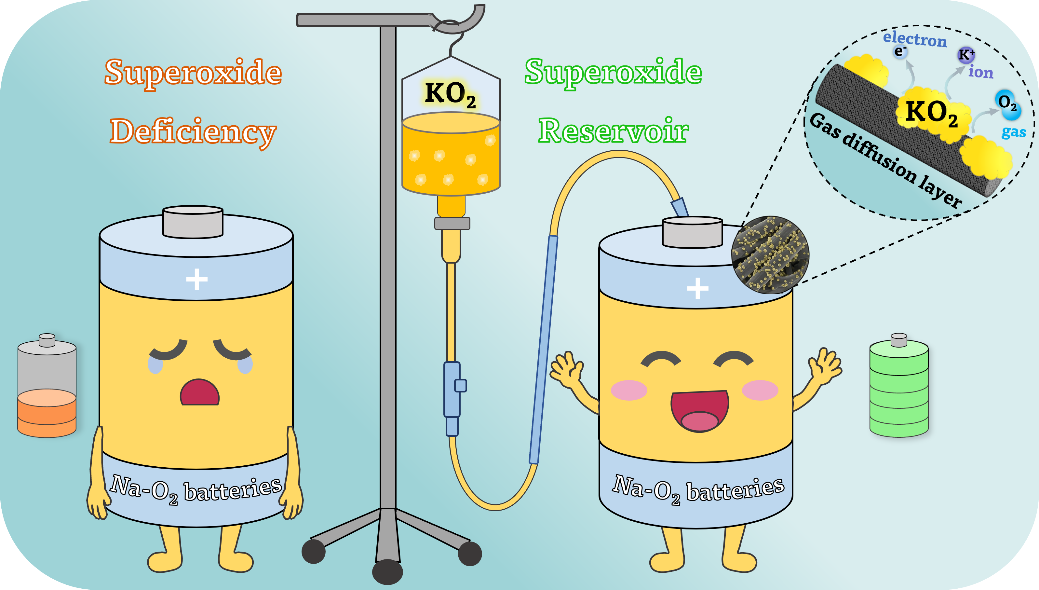
Figure 1. Schematic diagram of a KO2-based solid superoxide reservoir for irreversible capacity compensation in superoxide-based Na–O2 batteries.



