In September 2026, a research team led by Professor Chunyu Ding from the Institute for Advanced Study at Shenzhen University, in collaboration with Professor Yachen Xie’s team at Sichuan University and other institutions, published new findings on lunar near-surface exploration in IEEE Transactions on Geoscience and Remote Sensing. The study employed bistatic radar observations using a 500 MHz ground-based radar system in Qujing, Yunnan Province, and the Five-hundred-meter Aperture Spherical Radio Telescope (FAST) to quantitatively estimate regolith thickness in the Rimae Bode region, a potential landing site for China's future crewed lunar missions. Jiangwan Xu, a doctoral student at Shenzhen University, is the first author, while Professor Chunyu Ding and Professor Yachen Xie serve as the corresponding authors.
Lunar regolith preserves a long history of impact events, volcanic activity, and space weathering. Its thickness and spatial distribution are also important for landing site assessment, scientific sampling, and future lunar surface infrastructure. Located in the transition zone between the lunar maria and highlands on the Moon's nearside, Rimae Bode is of considerable scientific interest. To address the challenge of characterizing regional near-surface structures before spacecraft arrival, the team adopted a bistatic observation configuration in which the Qujing radar transmitted signals toward the Moon while FAST received the radar echoes (Fig. 1). This approach takes advantage of FAST's high receiving sensitivity to support ground-based radar investigations of the target region.
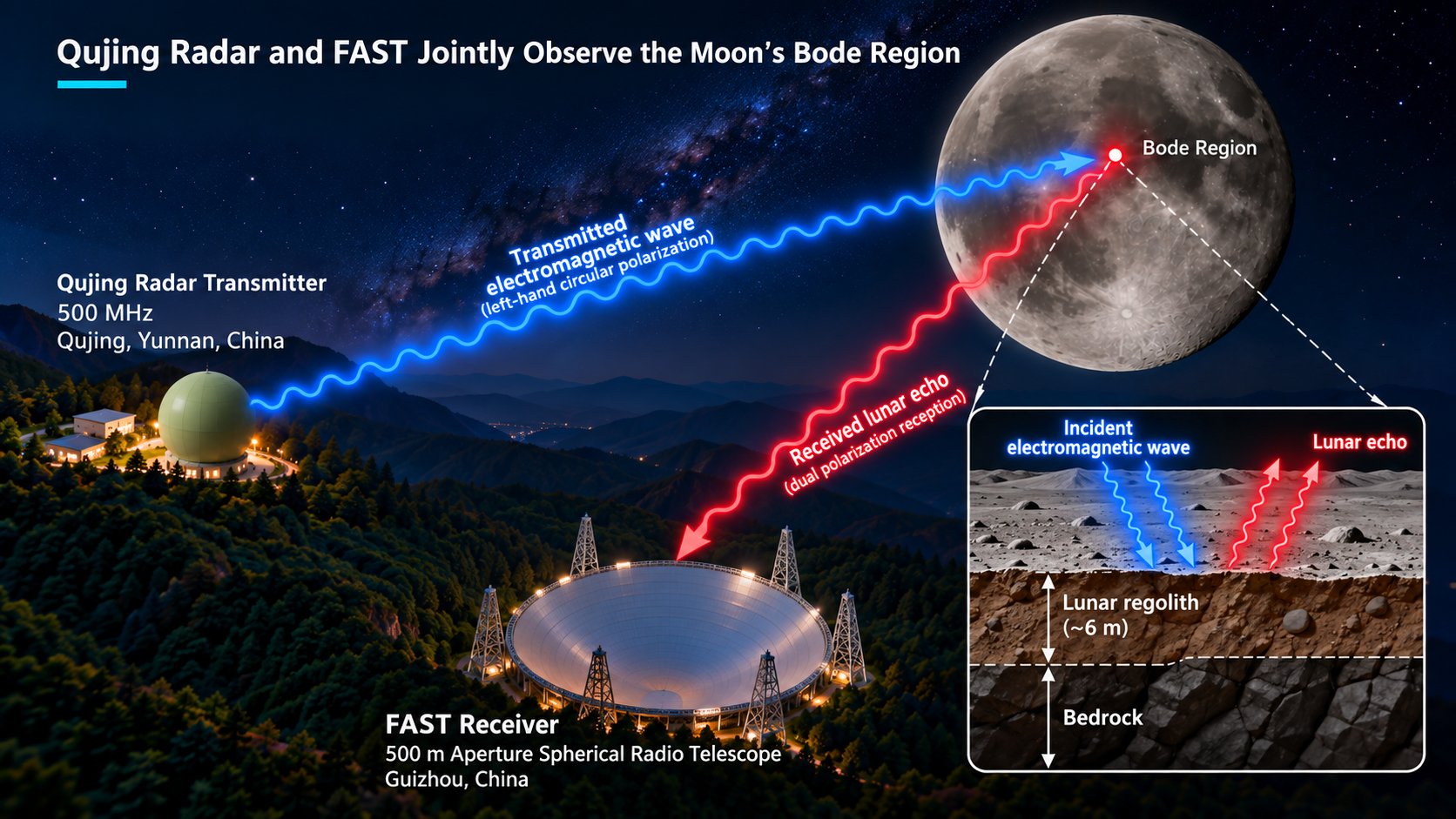
Fig. 1 | Schematic illustration of bistatic lunar radar observations using the Qujing ground-based radar and FAST.
The team used the previously determined regolith thickness at the Chang'e-3 landing site as a calibration reference and incorporated titanium dioxide (TiO₂) and iron oxide (FeO) abundances derived from Clementine multispectral observations to constrain the dielectric properties of lunar regolith. By jointly analyzing surface reflections, internal scattering, and radar responses associated with the regolith–bedrock interface (Fig. 2), the researchers developed a regional regolith thickness inversion method, providing a new approach for quantitative investigations of the lunar near-surface environment.
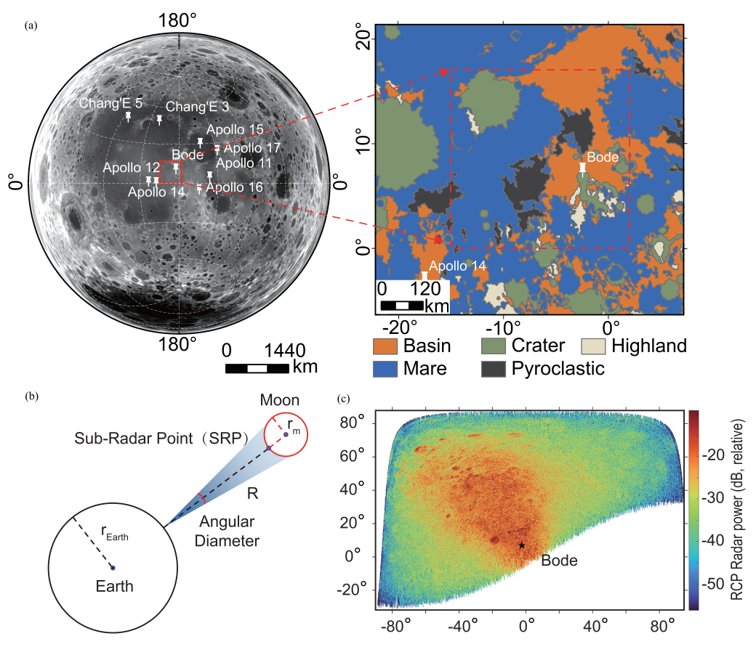
Fig. 2 | Geological setting of the Rimae Bode region and results of the bistatic radar observations.
The study produced a regional regolith thickness map with a spatial resolution of approximately 2–3 km (Fig. 3). The results indicate an average regolith thickness of approximately 6 m, with most values ranging from 4 to 9 m and substantial spatial variability. Relatively thick regolith, typically around 8 m, occurs in the southeastern part of the study area and portions of the volcanic deposits, whereas thinner regolith, approximately 4 m, is found in some mare units and mare–highland transition zones. These variations may reflect differences in volcanic activity, impact ejecta deposition, and regional geological evolution. The findings provide quantitative constraints for assessing geological conditions at potential crewed lunar landing sites.
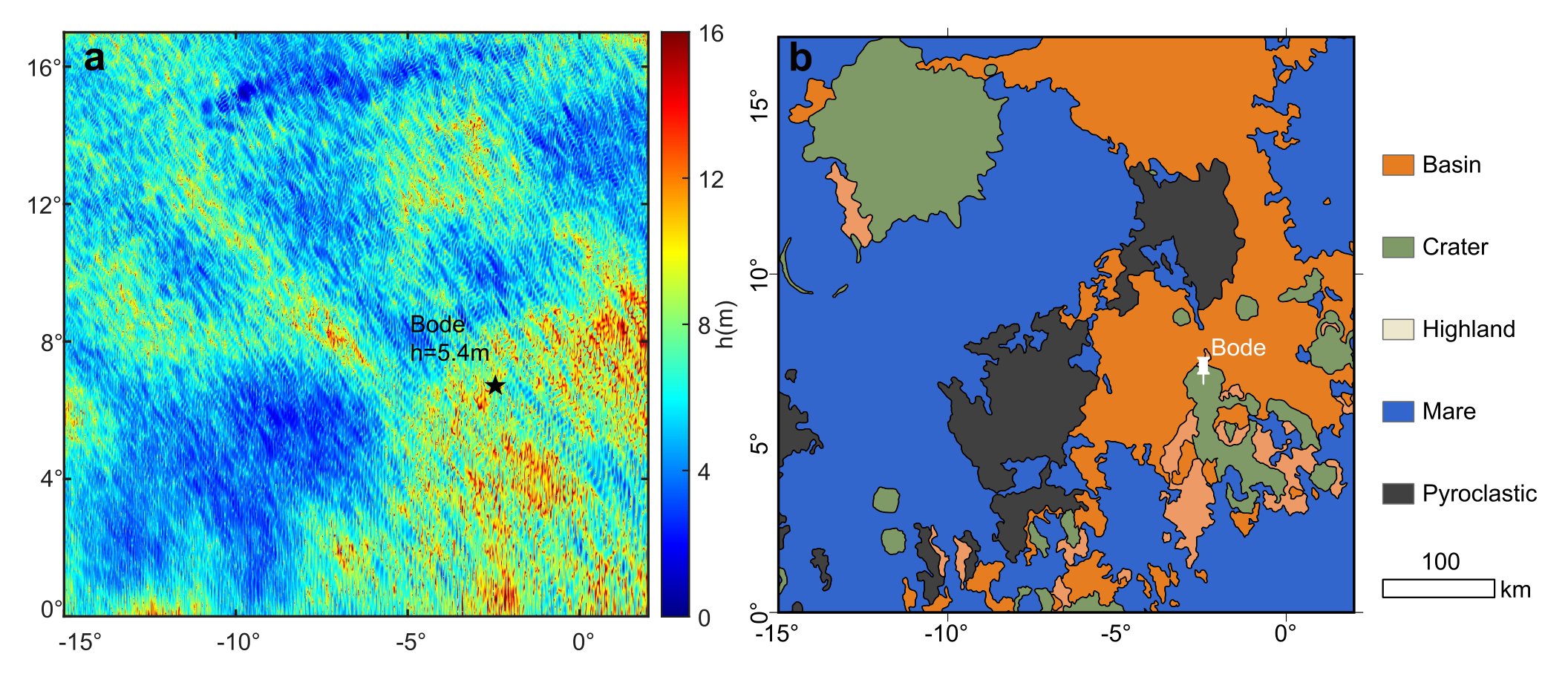
Fig. 3 | Radar-derived regolith thickness map (left) and geological unit map (right) of the Rimae Bode region.
The researchers also proposed an integrated exploration strategy combining multifrequency radar observations with targeted drilling. Radar systems operating at different frequencies could be used to investigate deeper geological structures, characterize the main regolith layer, and resolve fine-scale features near the lunar surface, while drilling would provide in situ validation. This strategy offers a potential framework for future crewed lunar missions, linking regional geological surveys with detailed local investigations. The study further demonstrates the potential of integrating ground-based radar systems with large radio telescopes for investigating the Moon's subsurface structure.
The research was conducted with contributions from scientists at the 22nd Research Institute of China Electronics Technology Group Corporation, the National Astronomical Observatories and the Institute of Geochemistry of the Chinese Academy of Sciences, the National Research Council of Italy, and other collaborating institutions.
This work was supported by the National Natural Science Foundation of China, the Natural Science Foundation of Guangdong Province, the Sichuan Science and Technology Program, the Science and Technology Development Fund (FDCT), the Shenzhen Science and Technology Innovation Commission, and Shenzhen University's 2035 Program for Pursuing Excellence in Research.
Paper DOI: https://doi.org/10.1109/TGRS.2026.3733555



